Where is your young adult on the path to independence? It’s a question that keeps you up at night. You see glimpses of capability—a meal cooked, a bus caught, a problem solved—but you also see the gaps. The forgotten appointments. The unopened bills. The reluctance to try something new. You want to help, but you don’t know where to start.
The truth is, you can’t address what you haven’t measured. Before you can create a plan, you need a clear picture of where your young adult stands right now. Not in comparison to some idealized version of adulthood, but in relation to the specific skills that will allow them to live the life they want.
This checklist is that starting point. It’s not a test. It’s not a judgment. It’s a tool to help you see the full landscape—the strengths to celebrate and the areas that need support. Think of it as a roadmap. You can’t navigate to a destination if you don’t know where you’re starting from.
Let’s find out where you are.
How to Use This Checklist (And Why It Matters)
Before you dive in, understand what this tool is and what it isn’t.
This checklist IS:
- A snapshot of your young adult’s current skills across six key domains of independence
- A tool for identifying priority areas for growth
- A starting point for creating an action plan
- A way to track progress over time
This checklist IS NOT:
- A diagnostic tool for autism
- A measure of your young adult’s worth or potential
- A comparison to neurotypical peers
- A pass/fail test
The goal here is clarity, not perfection. Every young adult is on their own timeline. Some will master certain skills quickly and struggle with others for years. That’s okay. What matters is that you know where to focus your energy and resources.
The Rating System
For each skill, you’ll assign one of three ratings:
- Mastered: Your young adult can perform this skill independently, without prompting or support, on a consistent basis.
- In Progress: Your young adult can perform this skill with reminders, partial support, or in some situations but not others.
- Not Yet Started: Your young adult has not yet learned or attempted this skill, or requires full support to complete it.
Be honest. This assessment is for you, not for anyone else. The more accurate your responses, the more useful the results will be.
Domain 1: Personal Care & Hygiene Skills
Personal care is the foundation of independence. These are the daily routines that keep us healthy, safe, and socially appropriate. For many autistic young adults, these routines need to be explicitly taught and practiced until they become automatic.
Assessment Questions:
- Does your young adult shower or bathe independently, including washing hair and body thoroughly?
- Do they brush their teeth twice daily without reminders?
- Do they use deodorant daily without prompting?
- Do they maintain clean, trimmed fingernails and toenails?
- Do they wash their face morning and evening?
- Do they comb or style their hair appropriately for the day?
- Do they shave (if applicable) regularly and safely?
- Do they recognize when clothing is dirty and needs changing?
- Do they dress appropriately for the weather and occasion?
- Do they manage menstrual hygiene independently (if applicable)?
- Do they recognize when they are sick and need to rest or seek medical care?
- Do they take prescribed medications on time without reminders?
- Do they maintain a consistent sleep schedule?
- Do they recognize and respond to hunger and thirst cues appropriately?
- Do they practice good hand hygiene (washing hands after using the bathroom, before eating)?
Your Score: _____ Mastered / _____ In Progress / _____ Not Yet Started
Priority Level: If fewer than 10 skills are mastered, this should be a high priority focus area. Personal care directly impacts health, social acceptance, and employability.
Domain 2: Household Management Skills
Running a household requires planning, organization, and consistent effort. These skills are essential for anyone who wants to live independently or semi-independently.
Assessment Questions:
- Do they make their bed every morning without reminders?
- Do they keep their bedroom or living space organized and clutter-free?
- Do they clean up after themselves in shared spaces (kitchen, bathroom)?
- Do they do their own laundry, including sorting, washing, drying, and folding?
- Do they put away clean clothes in appropriate places?
- Do they vacuum or sweep floors weekly?
- Do they clean the bathroom (toilet, sink, shower) thoroughly?
- Do they wash dishes or load the dishwasher after meals?
- Do they take out the trash when it’s full?
- Do they recognize when household supplies (toilet paper, soap, food) are running low?
- Do they perform basic home maintenance (changing light bulbs, unclogging drains)?
- Do they know how to operate household appliances safely (washer, dryer, microwave, oven)?
Your Score: _____ Mastered / _____ In Progress / _____ Not Yet Started
Priority Level: If fewer than 8 skills are mastered, this should be a medium-high priority. These skills are necessary for residential independence.
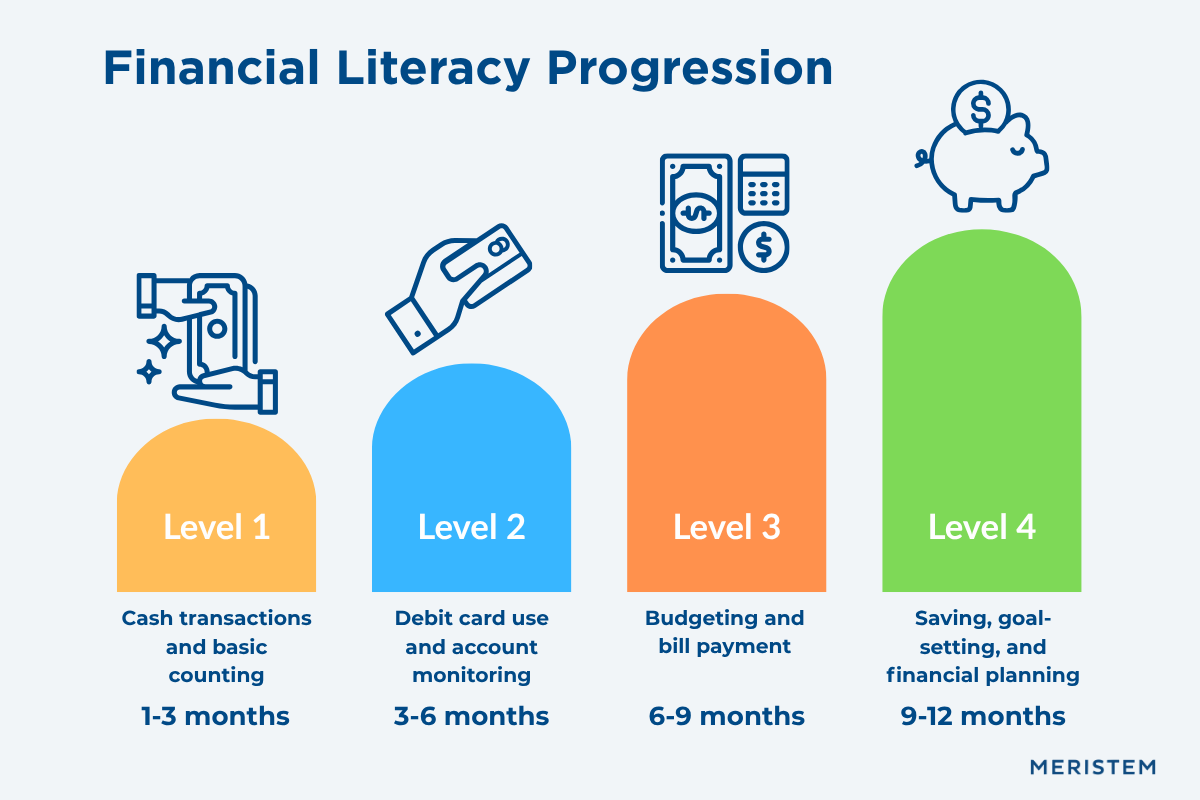
Domain 3: Financial Literacy & Money Management
Money management is one of the most critical—and most challenging—areas of independence. Without these skills, even the most capable individual can end up in financial crisis.
Assessment Questions:
- Do they understand the value of money and can they count coins and bills accurately?
- Do they make purchases with cash and verify they receive correct change?
- Do they use a debit card for purchases?
- Do they check their bank account balance regularly?
- Do they understand the difference between debit and credit?
- Do they create and stick to a monthly budget?
- Do they track their income and expenses?
- Do they pay bills on time (rent, utilities, phone)?
- Do they save money for specific goals?
- Do they recognize common scams (phone, email, text) and protect their personal information?
Your Score: _____ Mastered / _____ In Progress / _____ Not Yet Started
Priority Level: If fewer than 6 skills are mastered, this should be a high priority. Financial vulnerability can undermine all other areas of independence.
Domain 4: Transportation & Navigation Skills
Transportation is the gateway to employment, education, and social connection. Research shows that employed autistic adults are significantly more likely to use independent forms of transportation than their unemployed peers.
Assessment Questions:
- Do they read and understand bus or train schedules?
- Do they use transit apps to plan routes?
- Do they identify the correct bus or train number and direction?
- Do they know when to get off at their destination?
- Do they navigate walking routes using GPS or maps on their phone?
- Do they recognize key landmarks and use them for navigation?
- Do they ask for help when lost or confused?
- Do they practice safe behavior while waiting for and riding public transportation?
Your Score: _____ Mastered / _____ In Progress / _____ Not Yet Started
Priority Level: If fewer than 5 skills are mastered, this should be a high priority, especially if employment or education is a goal. For more guidance, see our article on Transportation Independence for Autistic Adults.
Domain 5: Healthcare & Safety Skills
Healthcare self-advocacy and safety awareness are often overlooked but absolutely essential. These skills can be life-saving.
Assessment Questions:
- Do they schedule their own doctor and dentist appointments?
- Do they arrive on time for appointments?
- Do they describe symptoms clearly to healthcare providers?
- Do they ask questions about their diagnosis and treatment?
- Do they take medications as prescribed without reminders?
- Do they refill prescriptions before running out?
- Do they know when and how to call 911?
- Do they know their emergency contacts and how to reach them?
- Do they understand basic first aid (treating cuts, burns, choking)?
- Do they recognize unsafe situations and remove themselves?
Your Score: _____ Mastered / _____ In Progress / _____ Not Yet Started
Priority Level: If fewer than 6 skills are mastered, this should be a high priority. Safety and health cannot be compromised.
To download a PDF copy of this checklist, click here.
Domain 6: Social & Communication Skills
Social and communication skills are the glue that holds everything else together. They allow your young adult to ask for help, navigate social situations, advocate for themselves, and build relationships. Adaptive behavior assessments consistently show that social communication is a key predictor of independence outcomes.
Assessment Questions:
- Do they initiate conversations appropriately with peers and adults?
- Do they maintain appropriate eye contact and body language during conversations?
- Do they ask for help when they need it?
- Do they advocate for their needs and accommodations in school, work, or community settings?
- Do they recognize and respect social boundaries (personal space, privacy)?
- Do they handle conflict or disagreements calmly and appropriately?
- Do they recognize when someone is being unkind or taking advantage of them?
- Do they make and maintain friendships?
- Do they participate in social activities or groups?
- Do they manage loneliness and seek out social connection when needed?
- Do they regulate their emotions and avoid meltdowns in public settings?
- Do they understand and follow unwritten social rules in different settings (library, restaurant, workplace)?
Your Score: _____ Mastered / _____ In Progress / _____ Not Yet Started
Priority Level: If fewer than 7 skills are mastered, this should be a medium-high priority. Social skills impact employment, relationships, and quality of life.
Interpreting Your Results: What Do the Numbers Mean?
Now that you’ve completed the assessment, it’s time to make sense of the results. Add up your totals across all six domains.
| Domain | Mastered | In Progress | Not Yet Started |
|---|---|---|---|
| Personal Care & Hygiene (15 skills) | |||
| Household Management (12 skills) | |||
| Financial Literacy (10 skills) | |||
| Transportation & Navigation (8 skills | |||
| Healthcare & Safety (10 skills) | |||
| Social & Communication (12 skills) | |||
| TOTAL (67 skills) |
What Your Score Tells You:
- 45+ Skills Mastered: Your young adult has a strong foundation for independence. Focus on the remaining “in progress” skills and begin exploring semi-independent or independent living options.
- 30-44 Skills Mastered: Your young adult is making solid progress but still needs significant support in several areas. This is an ideal time to enroll in a comprehensive life skills program like Meristem’s Self-Leadership Program.
- 15-29 Skills Mastered: Your young adult is in the early stages of building independence. Focus on foundational skills (personal care, safety, basic household tasks) before moving to more complex areas.
- Fewer than 15 Skills Mastered: Your young adult needs intensive, structured support to build independence skills. Consider working with occupational therapists, life skills coaches, or enrolling in a residential program designed for skill-building.
Remember: These numbers are not a judgment. They are a starting point. Every young adult progresses at their own pace.
Creating Your Action Plan: What Comes Next?
An assessment without action is just information. The real value of this checklist is what you do with it. Here’s how to turn your results into a concrete plan.
Step 1: Identify Your Top 3 Priority Areas
Look at your scores across the six domains. Which domains have the fewest “mastered” skills? Which domains are most critical for your young adult’s immediate goals (e.g., if they want a job, transportation is critical)?
Write down your top 3 priority domains:
- __________________________________________________________________________________
- __________________________________________________________________________________
- __________________________________________________________________________________
Step 2: Choose 1-2 Specific Skills to Focus On
Within each priority domain, choose 1-2 specific skills that are currently “in progress” or “not yet started.” Don’t try to tackle everything at once. Focus creates momentum.
Priority Domain 1: _______________________________________________________________________
Target Skills: ___________________________________________________________________________
Priority Domain 2: _______________________________________________________________________
Target Skills: ___________________________________________________________________________
Priority Domain 3: _______________________________________________________________________
Target Skills: ___________________________________________________________________________
Step 3: Set a Timeline and Accountability System
When will you work on these skills? Who will support your young adult? How will you track progress?
Practice Schedule: _________________________________________________________________________
Support Person: __________________________________________________________________________
Progress Check-In Date: _____________________________________________________________________
Step 4: Seek Professional Support
Some skills are difficult to teach at home. Professional programs can accelerate progress dramatically. At Meristem, we use experiential, nature-based learning to build all six domains of independence in an immersive, supportive environment. Our students don’t just learn these skills in a classroom; they live them every day on our 13-acre campus.
If your young adult scored below 30 skills mastered, or if you’re feeling overwhelmed by the task ahead, it’s time to explore professional support.
The Path Forward
Independence is not a destination; it’s a journey. This checklist is your map. You now know where your young adult stands and where you need to focus your energy. That clarity is powerful.
But you don’t have to walk this path alone. Programs like Meristem exist to provide the structure, expertise, and immersive practice that accelerate skill development. We’ve helped hundreds of young adults move from dependence to self-sufficiency, and we can help yours too.
For a deeper dive into the overall journey to independence, read our comprehensive Complete Guide to Independence for Autistic Young Adults.
From Assessment to Action: How the Meristem Method Builds Skills
Now that you’ve completed the checklist, you have a clear picture of your young adult’s strengths and areas for growth. The next step is action. At Meristem, we use the Meristem Method to systematically build skills across all six domains in this checklist. Our five-domain framework is designed to turn “in progress” and “not yet started” skills into mastered abilities:
- Life Skills & Social Skills: Our hands-on, experiential approach in real-world settings is the fastest way to build competence in the practical and social skills identified in this checklist.
- Therapeutic Movement: Many students struggle with skill development because of anxiety, sensory overwhelm, or poor body awareness. We address these underlying challenges through therapeutic movement practices.
- Land & Nature Immersion: Our 13-acre campus provides a supportive, low-stimulation environment where students can practice skills without the sensory and social overwhelm of traditional settings.
- Craft & Resistance Training: Building skills requires persistence and the ability to work through frustration. Craft work develops these capacities in a tangible, meaningful way that transfers to all areas of life.
- Self-Leadership & Executive Functioning: We don’t just teach students what to do—we teach them how to plan, organize, initiate, and problem-solve independently, which is the foundation of true self-sufficiency.
If you’ve identified areas for growth in this checklist, we can help. Learn how the Meristem Method can create a personalized action plan for your young adult.
Key Takeaways
- Assessment before action. You can’t create a plan without knowing where you’re starting from.
- Focus on priorities. Don’t try to tackle all 67 skills at once. Choose 3-6 target skills and build momentum.
- Progress, not perfection. Every skill mastered is a victory worth celebrating.
- Seek support when needed. Professional programs can provide the structure and expertise that accelerate growth.
Voices of Community Podcast
Join us for conversations with autistic adults, families, and professionals who are helping shape a more inclusive world. Each episode shares personal stories, insights, and perspectives from across the Meristem community and beyond.