Key Takeaways
The transition to adulthood is not just a logistical challenge for families. It is a profound emotional journey. This guide explores the complex feelings of grief, fear, and hope that accompany this life stage, and offers practical strategies for navigating them. We will examine the critical difference between protecting and enabling, discuss how to build genuine trust in your young adult’s capabilities, and make the case for why autism parent support is not optional — it is essential. Learning to let go is not an act of abandonment. It is one of the most loving things a parent can do.
The Parent’s Dilemma: Wanting Independence While Fearing the Unknown
Most parents spend years hoping their child will grow into a capable, independent adult. That hope does not disappear when a child is autistic. But it gets complicated. It gets layered with fear, with uncertainty, and with a deep awareness of how hard the world can be for someone who experiences it differently.
This is the dilemma at the heart of autism transition planning. You want independence for your child. You also want to protect them. And those two things can feel, at times, like they are pulling in opposite directions.
The fear is not irrational. It is born of love and lived experience. You have watched your child struggle. You have fought for services, navigated systems, and advocated in rooms where you were the only person who truly knew your child. The idea of stepping back from that role can feel like stepping off a cliff.
But fear cannot be the only voice in the room. It must be balanced with something equally real: a belief in your child’s potential, and a commitment to their growth even when that growth is uncomfortable for you.
Addressing the Fear: “What Will Happen After I’m Gone?”
This is the question that lives quietly in the background of every transition conversation. It does not always get said out loud, but it is almost always there. What happens to my child when I can no longer be there for them?
The most effective response to this fear is not reassurance. It is preparation. Families who take concrete steps to plan for the long term — establishing a special needs trust, writing a letter of intent that documents their child’s history and preferences, and building a network of people who know and care for their child — consistently report lower anxiety around this question. Not because the fear disappears, but because they have done something real about it.
The transition period itself is part of this preparation. Every skill your young adult builds, every relationship they form, every challenge they navigate with growing confidence is a direct answer to that question. The work being done now is the plan.
Grief and Letting Go: Normal Emotions in Transition
Letting go involves grief. That is not a sign that something is wrong. It is a sign that you are paying attention.
Parents in transition often describe grieving multiple things at once: the child they once knew, the future they imagined, and the role they have played for so many years. Research on family caregivers of autistic individuals consistently finds elevated levels of stress, anxiety, and grief — not because these parents are struggling, but because they are deeply invested.
Grief in this context does not move in a straight line. It circles back. A parent might feel at peace with the transition one week and devastated the next. Both are normal. The goal is not to eliminate grief but to make room for it alongside hope.
| What Parents Often Grieve | What Grows in Its Place |
|---|---|
| The daily caregiving role | A new kind of relationship built on trust |
| The child’s early years | Pride in who they are becoming |
| The future they imagined | A future shaped by the young adult themselves |
| Being needed in the old way | Being wanted in a new way |
The Difference Between Protecting and Enabling
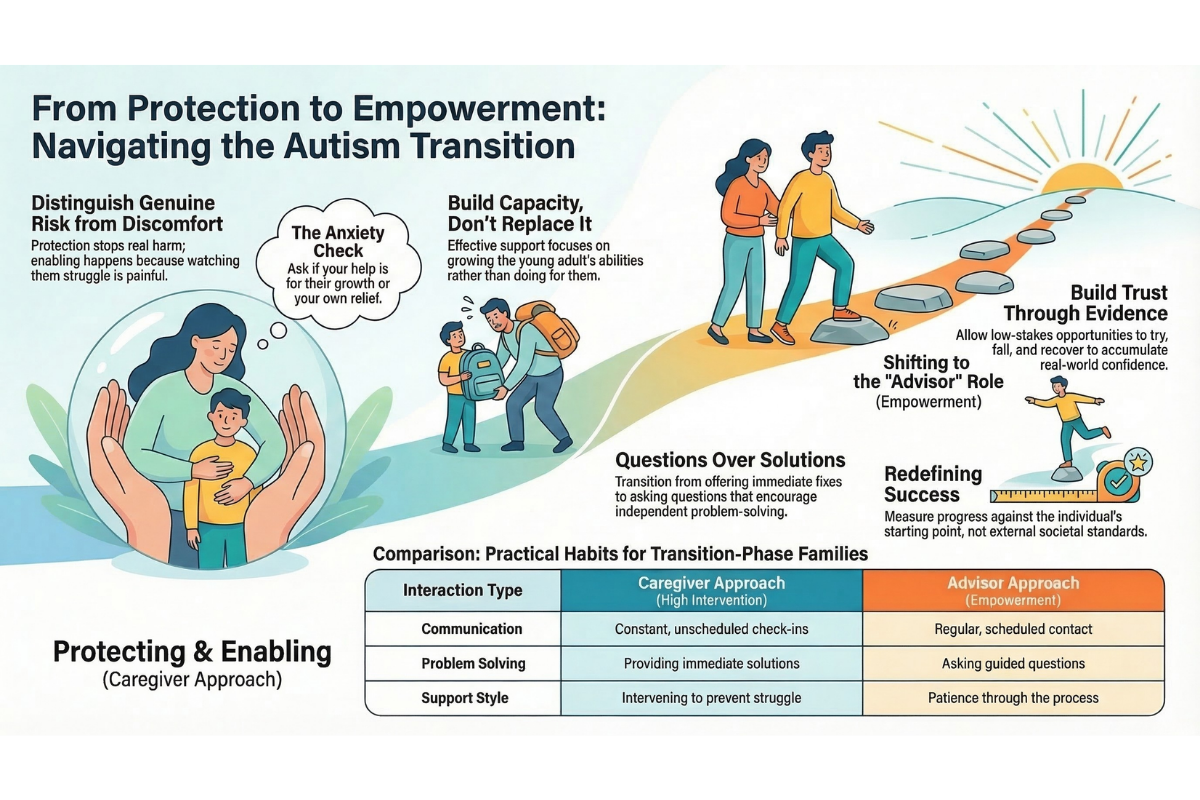
This is one of the most honest conversations in autism transition planning, and it is one that many parents find uncomfortable. There is a meaningful difference between protecting your child from genuine harm and doing things for them that they are capable of doing for themselves.
Protecting looks like: stepping in when your child is in a situation that poses real risk to their safety or wellbeing. Enabling looks like: stepping in because it is faster, because watching them struggle is painful, or because you are not sure they can handle it.
The line between the two is not always obvious. Psychology Today notes that for parents of neurodivergent young adults, this distinction is especially difficult because the need for support is real and legitimate. The question is not whether to support, but how. Support that builds capacity is different from support that replaces it.
A useful question to sit with: Is what I am doing helping my child grow, or helping me feel less anxious? Both motivations are understandable. But only one of them serves your child’s long-term independence.
Building Trust in Your Young Adult’s Capabilities
Trust is built through evidence. And evidence accumulates through experience. If your young adult is never given the opportunity to try, to fail, and to recover, you will never have the evidence you need to trust them. And neither will they.
Start small. Give your child opportunities to make their own choices in low-stakes situations. Let them decide what to cook for dinner, how to spend a free afternoon, or how to handle a minor conflict with a peer. As they demonstrate their ability to navigate these situations, the evidence grows. So does their confidence. So does yours.
Celebrate the small wins. Not with fanfare, but with genuine acknowledgment. A young adult who completes their laundry independently for the first time has done something real. Recognizing it matters.
Finding the Balance: Support Without Hovering
Your role as a parent is shifting. You are moving from primary caregiver to something more like a trusted advisor. You are still present. You are still important. But the nature of your involvement is changing.
This shift requires you to tolerate discomfort. You will watch your child make decisions you would not make. You will see them struggle with things that seem simple. You will want to step in. Sometimes you should. Often you should not.
The families who navigate this transition most successfully tend to share a few common practices: they maintain regular, scheduled contact rather than constant check-ins; they ask questions rather than offering solutions; and they have learned to distinguish between a situation that requires intervention and one that simply requires patience.
Celebrating Progress and Redefining Success
Success in autism transition planning rarely looks like what you imagined when your child was young. It looks like something smaller and more specific. It looks like a young adult who can manage their own laundry, maintain a friendship, hold a job they find meaningful, or navigate a grocery store checkout line with confidence.
These are not small things. They are the building blocks of a life. And they deserve to be recognized as such.
Redefining success is not about lowering expectations. It is about making them honest. It is about measuring progress against your child’s own starting point, not against an external standard that was never designed with them in mind.
READ MORE >> Autism Transition Planning: Preparing Your Young Adult for Life After High School
A Story Worth Telling
Abbie has been part of the Meristem community for many years, first in the Day Program and later making the courageous decision to try dorm living again after an initial attempt that did not work out. When she moved into the dorms, she brought with her a deep desire to be capable and to do things right, as well as a sincere commitment to her own growth.
In her first year in the dorms, everyday routines felt overwhelming. Unstructured time was hard. Laundry cycles got restarted without being finished. In stores, checkout lines sometimes triggered enough anxiety that she would freeze and feel unable to move forward.
Through persistence, reflection, and meaningful support from Meristem staff and her broader support network, Abbie has made remarkable progress. She now completes her laundry independently, remembers detergent, and allows her clothes to fully dry. In stores, she engages with cashiers and bags her groceries with care. She can manage her time and emotions without needing staff nearby, recognize when anxiety is rising, and understand how her habits affect how she feels.
Abbie’s journey is not finished. She continues to grow and still benefits from support. But her progress reflects something real: genuine resilience, growing self-trust, and the kind of inner confidence that allows a person to navigate real life with stability and dignity. For her family, watching that unfold has required patience, trust, and a willingness to let the process work.
Building a Support Network for Yourself
You cannot do this alone. That is not a weakness. It is a fact.
The parents who navigate this transition most effectively are the ones who have built a network of support for themselves, not just for their child. This may include a therapist or counselor who understands the specific dynamics of autism caregiving, a support group of other parents who are in the same season of life, and trusted friends or family members who can offer a listening ear without judgment.
Organizations like the Autism Society of America, the Association for Autism and Neurodiversity (AANE), and the National Alliance on Mental Illness (NAMI) all offer resources specifically for family members and caregivers. These are not resources for people who are failing. They are resources for people who are doing hard work and want to do it well.
The Importance of Self-Care for Parents
Self-care is not a luxury. For parents of autistic young adults navigating transition, it is a functional requirement. Research on caregiver burnout consistently shows that parents who neglect their own wellbeing are less effective advocates, less patient supporters, and more prone to anxiety and depression.
This does not mean elaborate wellness routines. It means sleep. It means time with people who restore you. It means activities that have nothing to do with caregiving. It means asking for help when you need it.
How to Handle Setbacks and Regression
There will be setbacks. There will be weeks when your child seems to be moving backward. This is a normal part of any developmental process. It does not mean the approach is wrong. It means growth is nonlinear.
When a setback occurs, the most useful thing you can do is resist the urge to immediately intervene. Give the process time to work. Consult with the professionals supporting your child. Ask what they are observing and what they recommend. And remind yourself that regression is often the precursor to a significant leap forward.
How Meristem Supports Families, Not Just Individuals
At Meristem, we believe that the transition to adulthood is a journey for the whole family. Our Independent Living Skills program includes regular communication with families, parent coaching to help navigate the emotional and practical dimensions of the transition, and family weekends that give parents the opportunity to connect with one another and to see their young adult’s growth firsthand.
We are not just preparing young adults for independence. We are supporting the families who love them through one of the most significant transitions of their lives.
Voices of Community Podcast
Join us for conversations with autistic adults, families, and professionals who are helping shape a more inclusive world. Each episode shares personal stories, insights, and perspectives from across the Meristem community and beyond.