What actually builds confidence in autistic young adults? Not praise. Not reassurance. Not telling them they are capable. Autism confidence building happens through competence. Through doing hard things. Experiencing real results. Developing a body of evidence that says, “I can handle this.” The research is clear on this point: self-efficacy, the belief in one’s own ability to succeed, is built through mastery experiences, not through being told you are good enough.
For many autistic young adults, confidence has been eroded by years of failure in environments that were not designed for them. School systems that penalized their communication style. Social situations that rewarded masking. Work environments that measured productivity in ways that did not account for how their brains actually function. The confidence gap is real, and it is not a character flaw. It is the predictable result of repeated exposure to the wrong environments.
The good news is that confidence is not fixed. It is built. And it can be rebuilt. Here are eight approaches that actually work.
A note before you read: every autistic young adult is different. Some of these approaches will resonate immediately; others may need to be adapted. Use this as a starting point, not a prescription. The goal is to find the combination that fits your young adult’s specific strengths, interests, and nervous system.
1. Mastery Experiences: Doing Hard Things and Succeeding
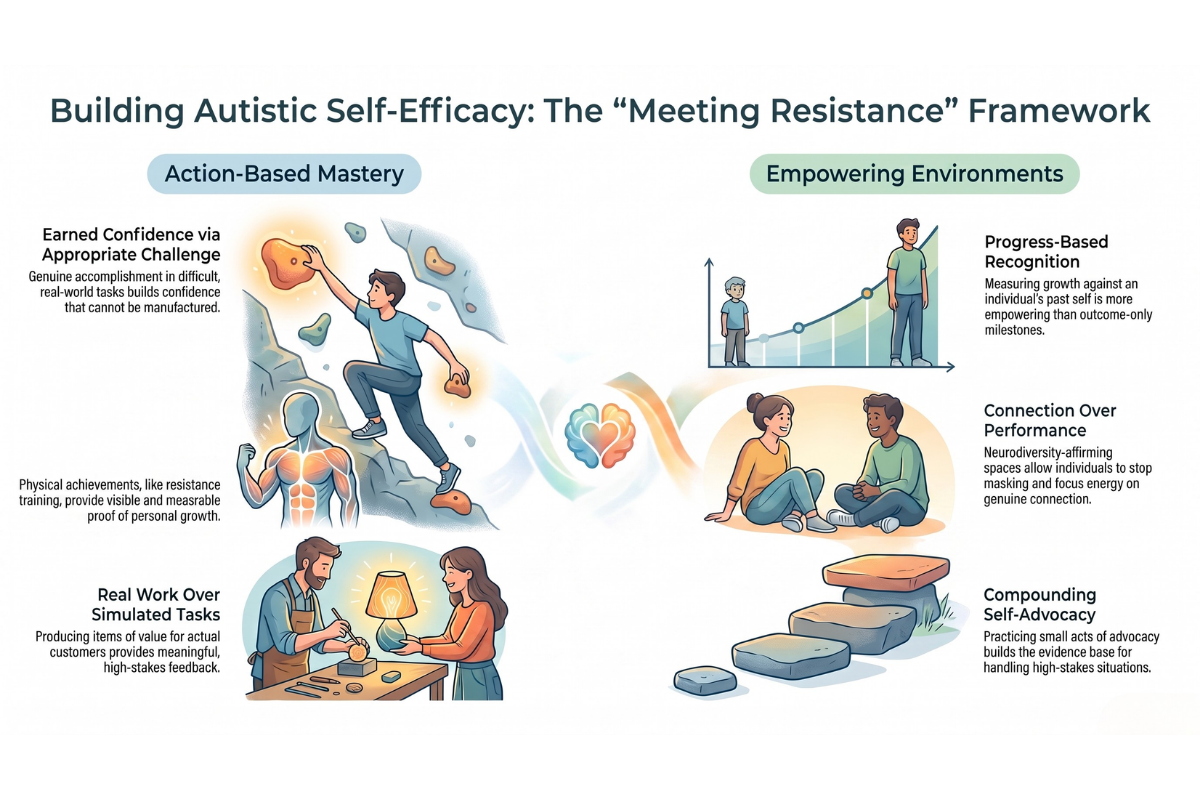
This is the foundation of everything else. Albert Bandura’s research on self-efficacy established decades ago that the most powerful source of confidence is direct experience of success — not simulated success, not near-success, but genuine accomplishment of something that was genuinely difficult.
The key word is “appropriate challenge.” A task that is too easy builds nothing. A task that is too hard builds only frustration. The sweet spot is a challenge that requires real effort, involves some risk of failure, and results in a tangible outcome the individual can point to and say, “I did that.”
This is why Meristem’s culinary program is not a cooking class. Students work in a real café, serve real customers, and manage real orders under real pressure. When a student completes a service shift, the confidence that comes from that experience is not manufactured. It is earned.
2. Physical Movement and Body Competence
The connection between physical competence and emotional confidence is well-documented. When the body learns to do something hard — lift a heavier weight, hold a yoga pose, complete a demanding hike — the nervous system registers that competence. It carries over.
Research on exercise and self-esteem in autistic individuals consistently shows that structured physical activity improves not just fitness, but self-perception, social engagement, and emotional regulation. The body and the mind are not separate systems. Building strength in one builds strength in the other.
Resistance training is particularly effective because progress is measurable and visible. When a young adult can lift more than they could last month, there is no ambiguity about whether they have improved. That clarity is powerful for people who often struggle to recognize their own growth.
3. Real-World Work with Tangible Results
Simulated tasks teach simulated confidence. Real work — work that produces something of actual value, for actual people — teaches the real thing.
This distinction matters enormously for autistic young adults who have spent years in educational settings where the stakes were artificial. When the work is real, the feedback is real. When a customer compliments a meal, when a product sells, when a colleague says “good job” because they genuinely mean it — that lands differently than a teacher’s grade.
Meristem’s 2025 Impact Report documented that students earned $146,000 in wages and completed 8,667 hours of paid work experience during the program year. Those are not participation trophies. They are evidence of real contribution, and they build a kind of confidence that no classroom exercise can replicate.
4. Self-Advocacy Practice
Confidence is not just about what you can do. It is also about knowing what you need and being able to ask for it. Self-advocacy — the ability to identify your own needs, communicate them clearly, and navigate systems on your own behalf — is one of the most practical confidence-builders available.
For autistic young adults, self-advocacy often starts small. Asking a cashier to repeat something. Requesting a quiet workspace. Telling a supervisor that a task needs to be broken into smaller steps. Each successful act of self-advocacy adds to the evidence base: “I can speak up for myself, and it works.”
Over time, this compounds. Young adults who learn to advocate for themselves in low-stakes situations develop the confidence to do so in high-stakes ones — job interviews, medical appointments, housing applications.
DOWNLOAD THE QUICK REFRENCE GUIDE: 8 Ways Autistic Young Adults Build Confidence That Actually Work
5. Interest-Led Learning and Deep Expertise
Autistic individuals often develop areas of deep, passionate interest. These are not quirks to be managed — they are assets to be developed. When a young adult is given the space and resources to build genuine expertise in something they care about, the confidence that follows is qualitatively different from the confidence that comes from completing assigned tasks.
Deep expertise also creates social currency. The young adult who knows everything about train schedules, or can identify every species of bird in the region, or can code a functional app from scratch, has something real to offer in a social or professional context. That expertise becomes a bridge to connection.
6. Peer Connection in Neurodiversity-Affirming Environments
Confidence is partly social. It is built in relationship to others. But for autistic young adults, the social environments where most people build confidence — school hallways, team sports, office small talk — are often the very environments that have eroded it.
Neurodiversity-affirming peer communities change the equation. When a young adult is surrounded by people who communicate similarly, share similar interests, and do not require masking as the price of admission, the social experience shifts. They stop spending energy on performance and start spending it on connection.
This is the social architecture that Meristem’s Social Growth program is built around. Shared activities, shared interests, and a campus culture where neurodivergent communication is the norm — not the exception.
7. Celebrating Progress, Not Just Outcomes
Most performance cultures — schools, workplaces, families — celebrate outcomes. You passed the test. You got the job. You finished the project. For autistic young adults who may take longer to reach conventional milestones, or who may never reach some of them at all, outcome-only recognition is demoralizing.
Progress-based recognition changes the frame. It asks: compared to where you were six months ago, how far have you come? That question is almost always answerable in a way that builds confidence, because growth — even slow growth — is almost always present when the environment is right.
This does not mean lowering standards. It means measuring against the right baseline.
8. Reducing Masking Demands
You cannot build genuine confidence while performing a version of yourself that is not real. Masking — suppressing autistic traits to meet neurotypical social expectations — is exhausting, and it actively undermines self-worth. When a young adult spends their energy pretending to be someone else, there is no energy left to discover who they actually are.
Reducing masking demands means creating environments where stimming is acceptable, where direct communication is valued, where silence is not interpreted as rudeness, and where sensory needs are accommodated without negotiation. In those environments, autistic young adults do not just feel more comfortable. They start to develop a positive relationship with their own identity — and that is the deepest form of confidence there is.
Building Confidence Takes the Right Environment
These eight approaches have something in common: none of them work in isolation, and none of them work in the wrong environment. Confidence is not built by telling someone they are capable. It is built by putting them in situations where they discover it for themselves — with the right support alongside them.
At Meristem, we call this “Meeting Resistance.” The idea is that growth happens at the edge of comfort, not inside it. Our programs are designed to provide exactly the right level of challenge, in an environment that is affirming, structured, and real. For a deeper look at the full framework, read our guide: How to Build Confidence in Autistic Young Adults: From Self-Doubt to Self-Efficacy.
Ready to explore programs that build real confidence? Learn more about Meristem’s approach to social and emotional development or visit our Classes and Offerings page.
Download the 2025 Impact Report
See the impact for yourself. Our 2025 Impact Report shares real outcomes. Employment, independence, and the milestones our students are reaching. Get your free copy below.
Voices of Community Podcast
Join us for conversations with autistic adults, families, and professionals who are helping shape a more inclusive world. Each episode shares personal stories, insights, and perspectives from across the Meristem community and beyond.