How can autistic students prepare for a successful return to school? Start before the first day by making the unfamiliar more predictable: practice routines, preview the environment, plan for sensory and executive-function demands, confirm available support, and build recovery time into the first weeks. The right plan looks different at every age, but the goal stays the same. Help the student enter the new term with more agency and less avoidable stress.
For some families, that means preparing a younger child for a new classroom, teacher, and bus route. For others, it means helping a young adult manage a college schedule, find a quiet place on campus, or speak with disability services. The situations differ, but each calls for turning a major transition into manageable steps. That is what families seeking back to school autism support are trying to do.
A quick note before we begin: autism is a spectrum, and no guide can predict exactly what one student will need. Your student may be excited, anxious, both, or neither. They may need extensive planning in one area and very little in another. Use this article as a framework for conversation and preparation, not as a checklist of what a student “should” be able to do.
Why the Back-to-School Transition Can Be So Demanding
A new term rarely changes just one thing. It often changes the route to school, daily schedule, teachers, peers, technology, workload, rules, sounds, lighting, meal routines, and expectations all at once. That accumulation matters. What looks like a small problem from the outside, such as a changed classroom or a new lunch schedule, can be the final demand in a day that already asks too much of the student’s attention and nervous system.
A systematic review of school transitions for autistic children found that transition planning should involve families and schools and continue after the first day. Although the review focused on younger children, its central lesson applies more broadly: readiness is not a trait a student either has or lacks. It depends on the fit between the student, the setting, the support, and the demands of the transition.
The Autism Research Institute’s back-to-school resources similarly recognize that schedule changes, new people, social expectations, and sensory demands can matter from grade school through college. A good plan prepares the whole day, not just the supplies list.
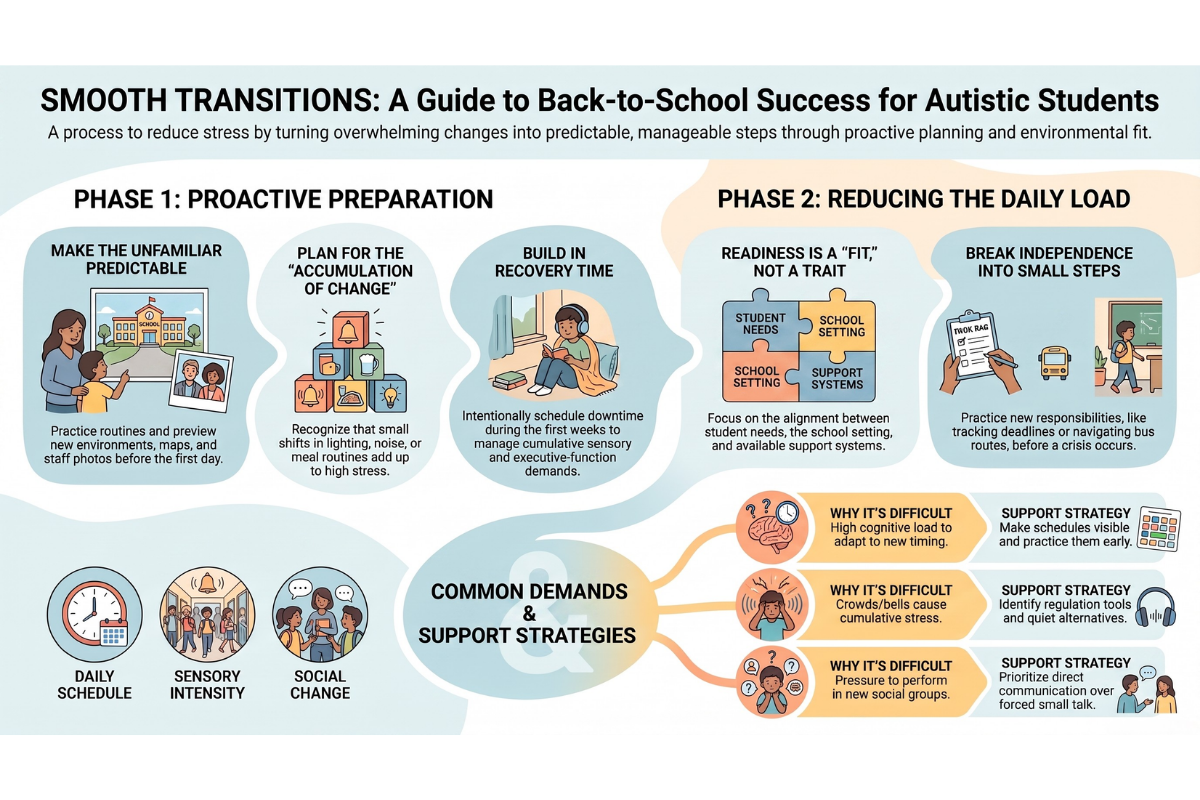
| Common back-to-school demand | Why it can feel difficult | A support that can reduce the load |
|---|---|---|
| A different daily schedule | The student has to hold more new information in mind and adapt to unfamiliar timing. | Make the schedule visible, practice it before the first day, and revise it after real-life trial runs. |
| New rooms, teachers, or technology | Unspoken rules and unfamiliar procedures can create uncertainty before coursework even begins. | Preview maps, classroom photos, learning portals, staff names, and basic procedures in advance. |
| Sensory intensity | Crowds, bells, bright lights, cafeterias, buses, and shared living spaces can add to cumulative stress. | Identify likely stressors and agree on practical regulation tools, breaks, and quieter alternatives. |
| Greater independence | The student may need to track deadlines, ask for help, manage materials, or travel independently. | Break each responsibility into small practice steps instead of waiting for a crisis to reveal the gap. |
| Social change | New classmates, group projects, roommates, and teachers can create pressure to perform socially. | Focus on direct communication, shared interests, and trusted points of contact rather than forced small talk. |
Start With the Student’s Own Priorities
Preparation works best when it begins with curiosity. Parents and educators may spot practical risks, but the student is the expert on what feels exciting, confusing, or overwhelming from the inside.
Ask: What are you looking forward to? What are you worried about? What part of the day do you not know how to handle yet? Younger students may answer through drawings, visual choices, or short conversations. A young adult may prefer a shared note on their phone or a conversation while walking.
This also supports self-advocacy. The Autistic Self Advocacy Network’s education resources emphasize meaningful access to academic and social spaces, not simply physical presence. When students name their needs and goals, they practice using their voice where it matters.
The questions change with age. A first grader may need to know where to take a quiet break. A middle-school student may need help tracking multiple teachers and assignments. A college student may need to decide whether, when, and how to disclose a disability to the campus office that coordinates accommodations. Build the plan with the student, not around them.
Make the New Routine Visible Before the First Day
A verbal reminder is often not enough. The routine needs to be concrete. It needs to be visible. For a school-age student, that might mean a visual morning sequence showing wake-up, dressing, breakfast, transportation, arrival, and first class. For a young adult, it may mean putting classes, study blocks, work shifts, meals, transit time, and recovery time into one digital calendar.
Executive-function demands can become especially visible when a student moves between classes, teachers, systems, and assignments. A study of fully included middle-school students with autism described challenges with planning, organization, task initiation, changing procedures, and asking for help or breaks. That does not define every autistic student. It does show why “just use a planner” is rarely enough on its own.
Try this four-part preparation sequence:
- Preview the routine. Walk through the schedule using a visual plan, campus map, photographs, virtual tour, or direct visit.
- Practice the routine. Complete the morning routine and travel route at least once under conditions that resemble the real day.
- Adjust the plan. Notice where time runs short, a step is unclear, or a sensory barrier appears. Change the plan before the first day if possible.
- Repeat after school begins. The first real week will reveal information no practice run can provide. Treat that information as useful, not as failure.
For young adults, practice does not need to mean taking over. Let the student try the transit route while you remain available by phone, or set up a calendar together and then step back so they can use it independently. Meristem’s guide to executive-function strategies offers additional ways to make planning and follow-through more concrete.
Plan for Sensory Needs and Emotional Regulation
A well-designed schedule can still fail if the sensory and emotional load is too high. The goal is not to remove every difficult sensation or feeling. School and adult life include discomfort. The goal is to make sure the student has a way to recognize rising stress, reduce unnecessary input, and recover before overwhelm becomes unmanageable.
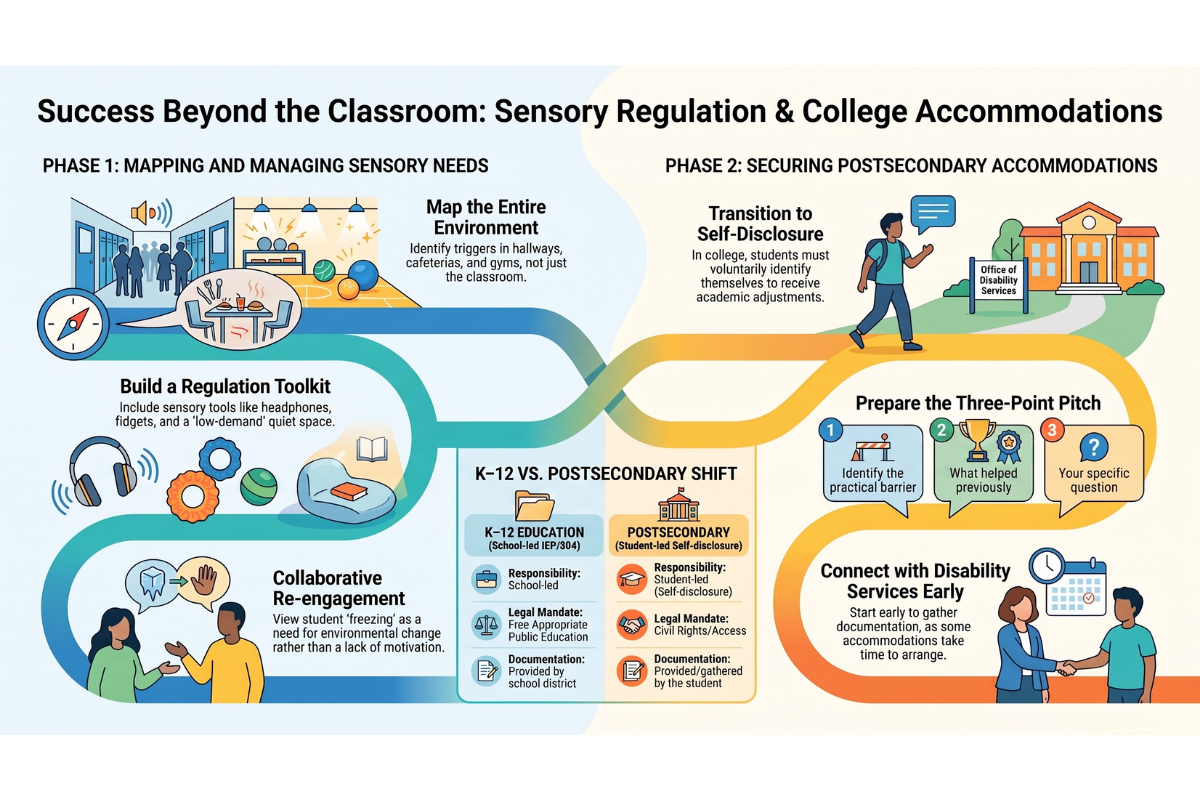
Start by mapping the environment. Which settings are likely to be loud, bright, crowded, rushed, or unpredictable? Think beyond the classroom. Transportation, hallways, cafeterias, gyms, residence halls, restrooms, waiting rooms, group projects, and campus events can all carry their own demands.
A regulation plan may include:
- A quiet or low-demand place the student can use during the day.
- Sensory tools that are welcome and practical for the setting, such as headphones, sunglasses, water, a small fidget, or a written break card.
- A clear way to ask for a break without needing to explain everything in the moment.
- Food, hydration, medication, and rest routines that do not get pushed aside by the new schedule.
- A decompression period after school or after a particularly demanding campus day.
The Asperger/Autism Network’s guidance on emotional regulation encourages parents to approach overwhelm collaboratively rather than labeling the student as unmotivated or difficult. That distinction is vital at back-to-school time. If a student freezes, withdraws, or becomes distressed, ask what needs to change so they can re-engage safely.
For a deeper discussion of early warning signs, recovery, and personal regulation tools, read Emotional Regulation for Autistic Adults: Understanding Meltdowns, Shutdowns, and Self-Regulation. Meristem’s Therapeutic Movement approach also treats body awareness and physical movement as part of the regulation process, not as an unrelated add-on.
Confirm Accommodations and Supports Early
For younger students, preparation may include reviewing an IEP or Section 504 plan, sharing useful information with a new teacher, and clarifying how the student will access breaks, visual supports, communication tools, or other agreed services. For students moving into college, career training, or adult education, the process changes.
The U.S. Department of Education’s Office for Civil Rights explains that postsecondary students who want academic adjustments generally need to identify themselves as having a disability and follow their school’s process for requesting support. Disclosure is voluntary. The process is also different from K–12: colleges do not operate under the same obligation to provide a free appropriate public education, and an IEP or Section 504 plan may help identify useful past supports without necessarily satisfying a college’s documentation requirements.
That is not a reason to panic. It is a reason to start early. Encourage the young adult to locate the disability-services office, read the institution’s procedure, gather relevant records, and ask what documentation and timelines apply. The Department of Education recommends requesting adjustments early because some take time to arrange. The student also needs to communicate when a support is not working.
Before the conversation, help the student prepare three things:
- The practical barrier. For example, a crowded testing room, a complex assignment portal, or a need for more processing time.
- What has helped before. A past support can provide useful context, even if the new setting uses a different process.
- The question they want answered. Direct questions create a more workable starting point than trying to explain every part of autism at once.
| Setting | Useful preparation questions | Practical next step |
|---|---|---|
| Elementary or middle school | Who will know the student’s support plan? How will transitions, communication, breaks, and meals be handled? | Schedule a short, student-centered meeting or send a concise one-page introduction before the term starts. |
| High school | What responsibilities is the student ready to own? What requires shared support? | Practice using a planner, school portal, transportation plan, and help-seeking script before the first full week. |
| College or vocational training | What is the process for requesting academic adjustments? What documentation is needed? Where are quiet spaces and support offices? | Contact disability services early, review the process, and let the student lead as much of the communication as they can. |
| Adult or transition program | Which daily-living, workplace, social, or transportation skills will the program require? | Build a schedule that includes program expectations, travel, meals, recovery, and a weekly review. |
Prepare for Social Changes Without Forcing Social Performance
A new school year brings new people. It does not require the student to become someone else.
The pressure to make friends immediately or keep up with constant conversation can turn a transition into a performance. Autistic students may need more time, clearer expectations, or interest-based settings to connect comfortably.
Instead, identify one or two realistic points of connection: a club built around a genuine interest, a study group with a defined purpose, a trusted staff member, or a regular activity. Small and specific beats broad and vague.
The Organization for Autism Research’s college self-advocacy guidance offers a helpful principle: self-advocacy includes knowing when to seek formal support and when to use practical strategies, such as finding a quieter place to work or declining an activity that does not fit the student’s needs. This is not social avoidance. It is informed choice.
Families can support that choice by avoiding scripts that make the student feel like a project. Debrief social experiences with curiosity: What felt good? What felt confusing? Did the student want more connection, less connection, or a different kind of connection? For more guidance, visit Autism and Friendship: How Autistic Young Adults Can Build Meaningful Relationships.
Back to School for Autistic Young Adults: College, Training, and Transition Programs
For autistic young adults, back to school is often also a step toward independence. Class schedules overlap with work shifts. Meals, laundry, transportation, housing, budgeting, healthcare, and study time all have to coexist.
Preparation becomes experiential here. A young adult can read a housing guide and still struggle with a checkout line, laundry, or asking a professor for clarification. Skills become more durable when they are practiced in real settings with enough support to make the next attempt possible.
That is the logic behind Meristem’s approach. On its 13-acre campus, young adults practice independence through real routines, peer relationships, movement, work, and community participation. In 2025, students completed 8,667 hours of paid work experience and earned $146,675 in wages. Working in the Meristem Café, managing a schedule, practicing transportation, and recovering after a demanding day are opportunities to meet resistance with support and build competence.
Families preparing a young adult for a new term can use the same principle at home. Practice one routine in the actual environment. Let the student make a call, send an email, navigate a route, prepare a meal, or manage a calendar with support nearby. Then talk about what happened. The Complete Guide to Independence for Autistic Young Adults and the Autism Transition Planning Checklist: Ages 14–25 can help families turn that larger goal into workable steps.
The First Month Matters More Than the First Day
The first day gets the attention. The first month reveals what the student actually needs.
A routine may feel manageable for a few days and become exhausting once the cumulative load appears. A student may need more travel time, different seating, a clearer deadline system, or fewer commitments while they adjust. That is not failure. It is useful information.
Use a short, specific weekly check-in.
| Notice | Ask | Adjust |
|---|---|---|
| A student is missing assignments or cannot begin homework. | “Is the issue knowing what to do, remembering it, starting it, or having enough energy left?” | Add a visual task list, break work into smaller steps, reduce competing demands, or ask the school about available support. |
| A student returns home shut down or distressed. | “What parts of the day used the most energy?” | Protect recovery time, identify sensory stressors, add a break plan, or simplify the evening routine. |
| A student avoids peers or group work. | “Do you want more connection, less connection, or connection that happens differently?” | Look for one interest-based or structured opportunity instead of pushing broad social exposure. |
| A support is not helping. | “What did you expect it to do, and what is happening instead?” | Communicate early with the relevant teacher, disability-services office, or support person and revise the plan. |
This is also a good moment to celebrate the right things. Not just grades, attendance, or a perfectly smooth day. Celebrate asking for help. Celebrate using a break before overwhelm. Celebrate a revised plan that works better than the first one. Those are signs of growing self-knowledge and self-advocacy.
When Structured Support Can Help
Parents should not have to be the only planners, coaches, social coordinators, and crisis managers in a young adult’s life. Sometimes the student needs a setting where real-world skills can be practiced with peers, structure, and professional support.
Meristem’s programs are designed around that kind of practice. In the culinary kitchen, on the farm, in a fitness session, while working with colleagues, or during an off-campus experience, students meet real demands and learn how to navigate them. The purpose is not to make life artificially easy. It is to create the conditions where competence can grow.
If your family is preparing for a school year, college program, or transition experience, explore Meristem’s Classes & Offerings and Social and Emotional Development resources. A strong plan helps students meet what comes next with confidence.
Download the 2025 Impact Report
See the impact for yourself. Our 2025 Impact Report shares real outcomes. Employment, independence, and the milestones our students are reaching. Get your free copy below.
Sign Up for Our Newsletter
Voices of Community Podcast
Join us for conversations with autistic adults, families, and professionals who are helping shape a more inclusive world. Each episode shares personal stories, insights, and perspectives from across the Meristem community and beyond.