Key Takeaways: Executive Function Strategies for Autism
Executive function challenges are a core feature of autism, impacting nearly every aspect of daily life. These 7 evidence-based strategies provide a practical toolkit for building skills in planning, organization, and self-regulation. For a broader look at how these skills fit into the bigger picture of autonomy, read our Complete Guide to Independence for Autistic Young Adults.
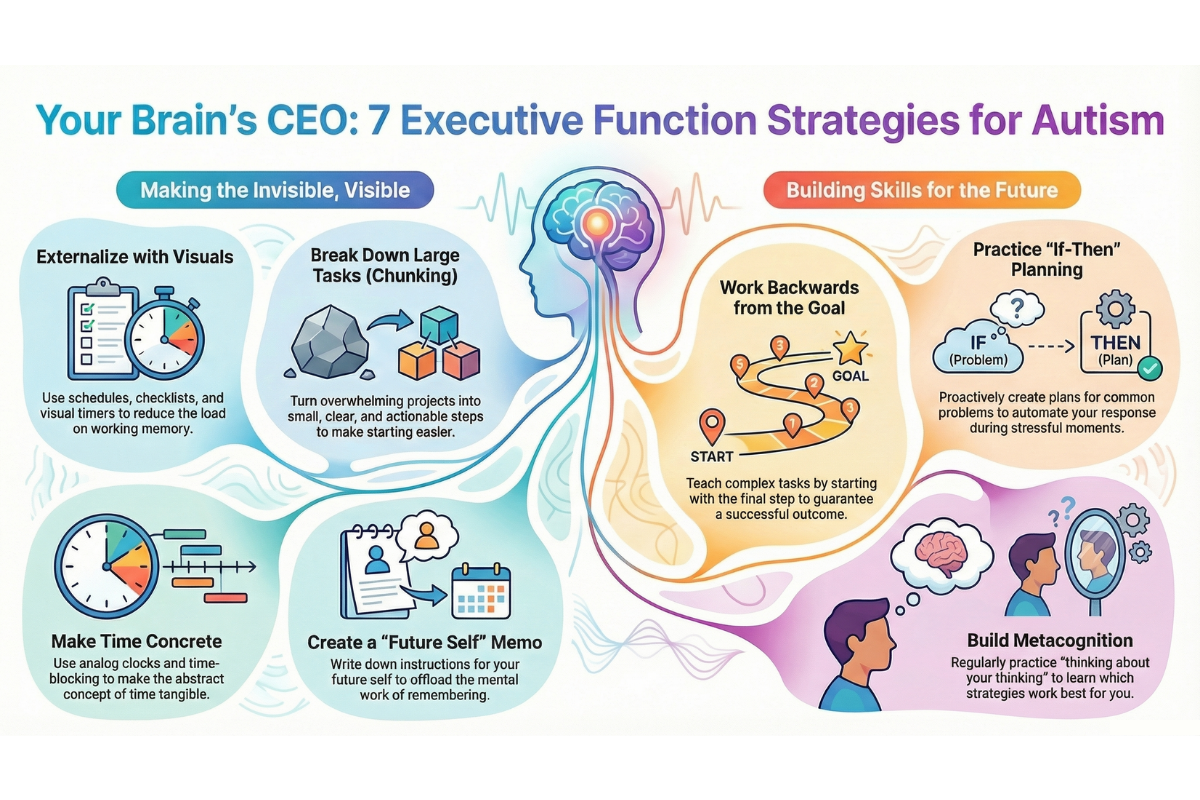
The 7 Executive Function Strategies Covered:
- Externalize Everything with Visuals: Make time and tasks visible using schedules, checklists, and timers.
- Break It Down (Task Chunking): Deconstruct large, overwhelming tasks into small, manageable steps.
- Work Backwards from the Goal: Use backward chaining to teach complex sequences and build momentum.
- Make Time Concrete and Tactile: Use analog clocks and time-blocking to make the passage of time feel real.
- Create a “Future Self” Memo: Write down instructions for a future self to reduce the cognitive load of remembering.
- Practice “If-Then” Planning: Proactively create plans for common problems and obstacles.
- Build Metacognition with Self-Reflection: Teach the skill of thinking about one’s own thinking to improve self-awareness and strategy use.
The Brain’s CEO: 7 Executive Function Strategies for Autism That Actually Work
Does your autistic young adult struggle to start tasks? Do they get lost in the middle of a project, forget important deadlines, or seem unable to manage their time? You’re not alone. These are not signs of laziness or defiance; they are classic signs of executive function challenges, a core and often invisible aspect of autism.
Executive functions are a set of mental skills that act as the “CEO of the brain.” They include planning, organization, time management, working memory, and self-control. As the Child Mind Institute explains, these skills are what allow us to set goals, create plans, and execute them effectively. For autistic individuals, these skills don’t develop as automatically as they do for their neurotypical peers. They must be explicitly taught and supported.
In our Complete Guide to Independence for Autistic Young Adults, we highlight how crucial these skills are for every aspect of adult life. Here, we’ll provide seven practical, evidence-based strategies you can use today to help your young adult strengthen their executive function and build a foundation for success.
1. Externalize Everything with Visuals
The single most effective strategy for supporting executive function is to make internal processes external and visible. Don’t rely on your young adult to “just remember.” Instead, put the information they need out in the world where they can see it.
Why It Works: Autistic individuals are often strong visual thinkers. Visual supports reduce the demand on working memory—the brain’s “sticky note” system—which is often a challenge area. By putting a schedule or checklist on the wall, you free up mental energy for actually doing the task.
How to Implement It:
- Visual Schedules: Use a whiteboard or a large wall calendar to map out the day or week. Include not just appointments, but also routines like “Shower,” “Cook Dinner,” and “Free Time.”
- Checklists for Routines: Break down multi-step routines (like the morning routine or a cleaning task) into a laminated checklist. They can physically check off each item as they complete it, providing a sense of accomplishment.
- Time Timers: Use a visual timer (like the Time Timer, which shows time as a shrinking red disc) to make the passage of time concrete. This helps with transitions and understanding how much time is left for a task.
2. Break It Down (Task Chunking)
A task like “clean your room” is not a single step; it’s a massive project that can be completely overwhelming. Task chunking involves breaking down large, vague tasks into small, specific, and actionable steps.
Why It Works: This strategy combats initiation challenges. When the first step is small and clear (e.g., “Put all dirty clothes in the hamper”), it’s much easier to get started. Each completed step provides a dopamine hit that builds momentum to tackle the next one.
How to Implement It:
- Co-create the Checklist: Sit down with your young adult and break down the task together. Ask them, “What’s the very first thing you need to do?” Write down each step on a checklist.
- Focus on Action Verbs: Start each step with a clear action verb. Instead of “Trash,” write “Put all trash in the trash can.”
- Estimate Time for Each Chunk: For young adults who struggle with time perception, add a time estimate next to each step (e.g., “Put clothes in hamper – 5 minutes”). This makes the overall task feel less endless.
| Overwhelming Task | Chunked Steps |
|---|---|
| Clean the Kitchen | 1. Clear all dishes from the counter.
2. Load the dishwasher. 3. Wipe down all counters. 4. Sweep the floor. |
3. Work Backwards from the Goal (Backward Chaining)
Backward chaining is a teaching technique where you start with the last step of a task. You complete all the initial steps, and the learner performs only the final, successful step. This is an incredibly powerful way to build confidence and motivation.
Why It Works: It ensures that the learner’s experience always ends with success. This creates a positive association with the task and makes them more willing to try it again. It’s particularly effective for tasks that have a clear, rewarding outcome, like baking cookies or assembling furniture.
How to Implement It:
- Baking Example: You mix the dough, scoop the cookies, and put them in the oven. Your young adult’s only job is to take the finished cookies out of the oven (with supervision). They immediately experience the reward: fresh-baked cookies!
- Next Time: You mix and scoop, and they put the cookies in the oven and take them out.
- Gradually Add Steps: You continue to move backward, having them do more of the final steps each time until they are completing the entire process on their own.
4. Make Time Concrete and Tactile
Time is an abstract concept. For many autistic individuals, “in 15 minutes” feels meaningless. You need to make time something they can see and feel.
Why It Works: It translates an abstract concept into a concrete, visual, or tactile one. This aligns with the autistic learning style and reduces anxiety around time-based demands.
How to Implement It:
- Use Analog Clocks: Digital clocks just show a number. Analog clocks show the “shape” of time. They make it easy to see the relationship between now and later. Use them everywhere.
- Time-Blocking on Paper: Use a paper planner and different colored highlighters to block out time for different activities (e.g., yellow for class, blue for homework, green for free time). This creates a visual map of the day.
- Connect Time to Actions: Instead of saying “We’re leaving in 10 minutes,” say “We’re leaving after you finish this episode.” This connects the transition to a concrete event rather than an abstract time.
5. Create a “Future Self” Memo
This strategy involves writing down instructions or reminders for your future self. It’s a way of offloading the mental work of remembering from a future, potentially stressed or overwhelmed brain.
Why It Works: It directly supports working memory and planning. It acknowledges that we can’t always trust our future selves to remember what our present selves know. It’s a form of self-compassion and a practical support.
How to Implement It:
- The “Go Bag” Checklist: Have a checklist on the back of the front door that lists everything they need before leaving (e.g., “Keys? Wallet? Phone? Lunch?”). This becomes a final check before transitioning out of the house.
- The “Homework Hand-In” Folder: Use a specific, brightly colored folder for all completed homework that needs to be turned in. The last step of any homework session is to put the work in that folder. The first step of packing their backpack in the morning is to put that folder in.
- Write Down the Plan: If they have a multi-step project, have them write down the next single step on a sticky note and put it on their computer or desk before they finish for the day. This makes it much easier to start again tomorrow.
6. Practice “If-Then” Planning
“If-Then” planning, also known as implementation intentions, is a powerful strategy for handling unexpected problems. It involves creating a plan ahead of time for how you will respond to a specific obstacle.
Why It Works: It automates the problem-solving process. When a problem arises, the autistic individual doesn’t have to generate a new solution from scratch while stressed. They just have to execute the pre-determined plan. Research has shown this to be a highly effective strategy for goal achievement.
How to Implement It:
- Identify Common Problems: Brainstorm common things that go wrong. What happens if the bus is late? What if you forget your lunch? What if a friend cancels plans?
Create the “If-Then” Rule: For each problem, create a simple rule. For example:- “If the bus is more than 10 minutes late, then I will call Mom to see if she can give me a ride.”
- “If I forget my lunch, then I will use my debit card to buy a sandwich from the cafeteria.”
- Write Them Down: Write these plans on index cards or in a small notebook that they can carry with them. This becomes their personal problem-solving guide.
7. Build Metacognition with Self-Reflection
Metacognition is “thinking about your thinking.” It’s the ability to step back and notice which strategies are working and which are not. This is the ultimate executive function skill, as it allows an individual to manage their own learning and adapt over time.
Why It Works: It moves the individual from being a passive recipient of strategies to an active user and creator of them. It builds self-awareness and empowers them to take ownership of their own support needs.
How to Implement It:
- Schedule a Weekly “Check-In”: Spend 15 minutes once a week reviewing the past week. Don’t focus on what went wrong, but on the process.
- Ask Reflective Questions: Use simple, non-judgmental questions:
- “What was the hardest part of this week?”
- “What strategy did you use to get through it?”
- “What’s one thing that worked really well?”
- “Is there a tool that would have made that easier?”
- Keep a “Strategy Log”: Have them keep a simple log of strategies they try and whether they worked. This helps them build a personalized toolkit of what works for their unique brain.
Conclusion: From Support to Strategy
The goal of executive function support is not to be a permanent external brain for your young adult. It is to provide temporary support while they build the internal skills to manage themselves. By using these seven strategies, you can move from providing constant prompting to teaching lasting skills. You can empower your autistic young adult to become the CEO of their own life, capable of navigating challenges with confidence and competence.
Voices of Community Podcast
Join us for conversations with autistic adults, families, and professionals who are helping shape a more inclusive world. Each episode shares personal stories, insights, and perspectives from across the Meristem community and beyond.