Audio Overview
Listen to this Article
Key Takeaways: Common Mistakes in Teaching Life Skills
Teaching life skills to an autistic young adult can be a frustrating process for both parent and child. Often, the biggest barriers are not the skills themselves, but the way they are taught. By avoiding a few common pitfalls, parents can transform a power struggle into a collaborative journey. This guide identifies four of the most common mistakes.
4 Common Mistakes to Avoid:
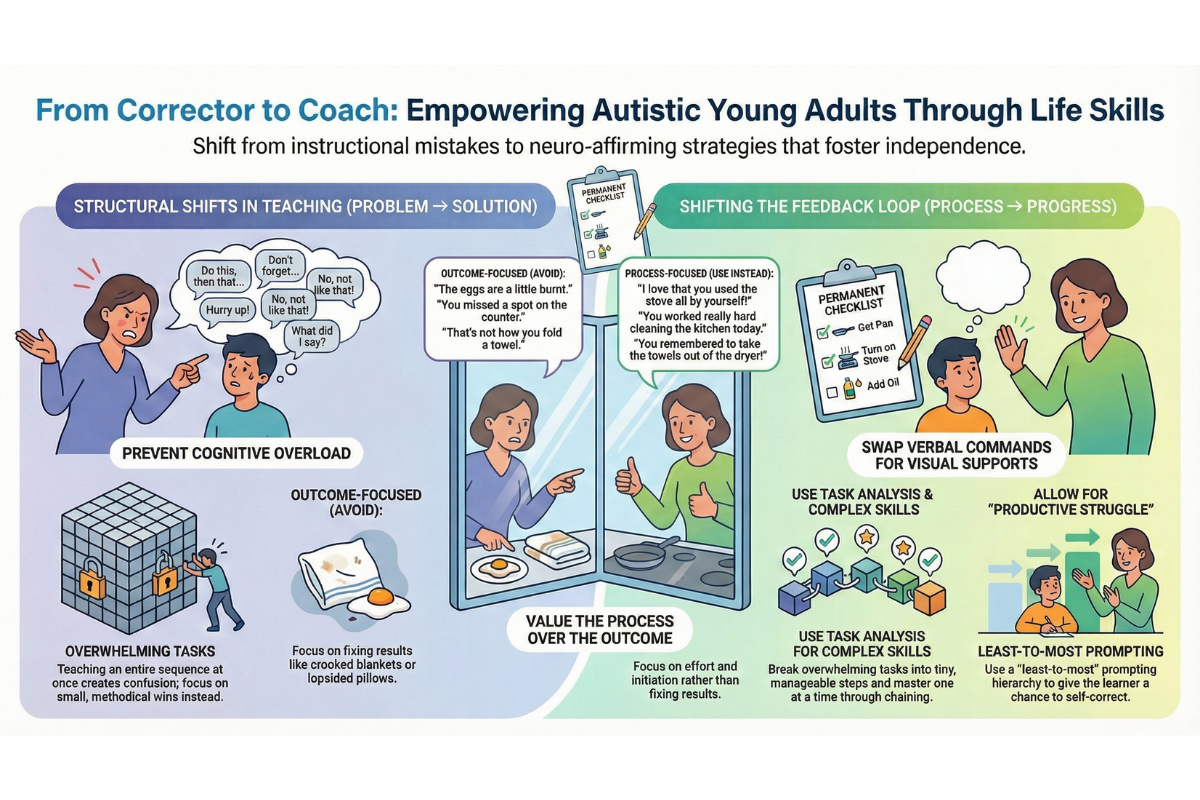
- Using Too Many Verbal Instructions: Relying on spoken words overloads an autistic person’s working memory. The solution is to use visual supports, which provide a concrete, permanent guide.
- Teaching an Entire Skill at Once: Complex skills like cooking or laundry are overwhelming when taught as a single task. The solution is to use task analysis to break the skill into small, manageable steps.
- Focusing on the Outcome, Not the Process: When the only goal is a perfectly made bed, the learning process becomes stressful. The solution is to praise the effort and celebrate small wins along the way, building confidence and resilience.
- Over-Prompting and “Fixing” Mistakes: Constantly correcting and jumping in to help creates dependence. The solution is to allow for productive struggle and use a system of least-to-most prompting to provide the minimum support necessary.
Are You Making These 4 Mistakes When Teaching Life Skills to Your Autistic Young Adult?
You’ve tried everything. You’ve explained the steps to load the dishwasher a dozen times. You’ve demonstrated how to sort the laundry. You’ve created a chore chart. Yet, the tasks remain undone, or they are done in a way that creates more work for you. It’s a cycle of prompting, frustration, and eventual surrender that leaves both you and your autistic young adult feeling defeated.
If this sounds familiar, you are not alone. The challenge often lies not in your child’s ability to learn, but in the subtle, well-intentioned mistakes we make in our teaching approach. As we explore in our Step-by-Step Guide to Teaching Life Skills, effective teaching requires us to meet the learner where they are. For autistic individuals, this means adapting our methods to support their unique neurology.
Are you inadvertently making the process harder? Let’s explore four of the most common mistakes parents make when teaching life skills, and how to shift your approach for better results.
Mistake #1: Using Too Many Verbal Instructions
The Scenario: You stand in the kitchen and say, “Okay, to make your lunch, you need to get the bread from the pantry, the turkey from the fridge, the mustard from the door, a plate from the cabinet, and a knife from the drawer.” Your young adult nods, but then stands frozen, unsure of where to begin.
The Mistake: You have just given a five-step verbal command. For a neurotypical person, this is manageable. For an autistic person, whose brain may struggle with auditory processing and working memory, this is an overwhelming flood of transient information. The words disappear as soon as they are spoken, leaving behind a vague sense of pressure and confusion.
The Solution: Stop Talking, Start Showing. The single most effective shift you can make is to rely on visual supports instead of verbal prompts. Visuals are permanent. They are concrete. They can be referenced as many times as needed without any social pressure. As noted in this report by the Tennessee Technical Assistance Network and the Vanderbilt Kennedy Center, this approach accommodates the visual-spatial strengths common in autistic individuals.
- Instead of explaining, create a simple, picture-based checklist for making a sandwich.
- Instead of reminding, point to a visual schedule that shows “Make Lunch” is the next activity.
- Instead of correcting, model the correct action silently.
Mistake #2: Teaching an Entire Skill at Once
The Scenario: You decide today is the day your young adult will learn to do their own laundry. You walk them through the entire process: sorting clothes, loading the machine, adding detergent, selecting the cycle, moving clothes to the dryer, and folding. By the end, they are visibly overwhelmed and have retained almost nothing.
The Mistake: “Doing laundry” is not one skill; it is a complex chain of at least a dozen smaller skills. By trying to teach the entire sequence at once, you are creating cognitive overload. The learner has no chance to master any single step before being rushed to the next one.
The Solution: Use Task Analysis to Teach One Step at a Time. Task analysis is the evidence-based practice of breaking a complex skill into its smallest component parts. You then teach one step at a time until it is mastered before moving on.
- Week 1 Goal: Master sorting clothes into two baskets (lights and darks). That’s it. You handle the rest.
- Week 2 Goal: Continue sorting, and now also master loading the clothes into the washing machine.
- Week 3 Goal: Sort, load, and now also add the correct amount of detergent.
This slow, methodical process, often called chaining, ensures that each step is solid before adding another. It may feel slow, but it’s the fastest path to true, independent mastery.
Mistake #3: Focusing on the Outcome, Not the Process
The Scenario: Your young adult has made their bed, but the comforter is crooked and the pillows are lopsided. Your immediate instinct is to say, “That’s not quite right,” and fix it for them.
The Mistake: When you focus only on the perfect outcome, you send the message that their effort wasn’t good enough. This can crush motivation and lead to a mindset of, “Why bother trying if I can’t do it perfectly?” It teaches them to fear mistakes rather than see them as learning opportunities.
The Solution: Praise the Effort, Not Just the Result. The goal of teaching life skills is not just to get the chore done; it’s to build confidence, resilience, and a sense of capability. This requires a shift in what you choose to praise.
| Instead of This (Outcome-Focused): | Try This (Process-Focused): |
|---|---|
| “The eggs are a little burnt.” | “I love that you used the stove all by yourself!” |
| “You missed a spot when you were wiping the counter.” | “Thank you so much for helping me clean the kitchen. You worked really hard.” |
| “That’s not how you fold a towel.” | “You remembered to take the towels out of the dryer! That’s a huge help.” |
By praising the process, you are reinforcing the behaviors you want to see (effort, initiation, follow-through) and creating a positive emotional association with the task.
Mistake #4: Over-Prompting and “Fixing” Mistakes
The Scenario: You see your young adult starting to pour too much milk into their cereal bowl. You rush over and say, “Whoa, that’s too much!” and take the milk carton from them to finish the job.
The Mistake: You have just robbed them of a valuable learning opportunity. Spilling a little milk is a low-stakes mistake with a natural consequence (a mess to clean up). By constantly intervening, you prevent them from learning from these natural consequences. This can inadvertently create learned helplessness, a state where an individual believes they are incapable of handling tasks on their own because someone has always done it for them.
The Solution: Allow for Productive Struggle and Use Least-to-Most Prompting. Productive struggle is the idea that learning happens when we are allowed to grapple with a problem just outside our current ability. Your job is to provide the minimum amount of support needed to prevent a total shutdown or a dangerous situation.
- Wait: Before you jump in, pause for 5-10 seconds. Give them a chance to notice and correct their own mistake.
- Use a Gestural Prompt: If they don’t notice, simply point to the rising milk level.
- Use a Verbal Prompt: If that doesn’t work, use a minimal verbal cue, like, “Check the milk.”
- Model: Only after all other prompts have failed should you model the correct action.
This least-to-most prompting hierarchy ensures you are providing just enough help to facilitate success without creating dependence. This article from Autism Speaks provides a great overview of different prompting levels.
Conclusion: Becoming a Coach, Not a Corrector
Each of these mistakes comes from a place of love and a desire to help. But to build true independence, we must be willing to shift our role from a manager who directs and corrects to a coach who guides and supports. By using visual supports, breaking down skills, praising the process, and allowing for productive struggle, you create an environment where your autistic young adult can build not just life skills, but a lasting sense of their own competence and value.
Voices of Community Podcast
Join us for conversations with autistic adults, families, and professionals who are helping shape a more inclusive world. Each episode shares personal stories, insights, and perspectives from across the Meristem community and beyond.