How do autistic young adults navigate a world that constantly overwhelms their sensory and emotional processing systems? Autism emotional regulation is not about suppressing feelings or forcing compliance. It is about understanding the unique neurology of the autistic brain, recognizing the early signs of dysregulation, and building a personalized toolkit to maintain balance. When autistic adults learn to work with their nervous systems rather than against them, they can move from chronic overwhelm to sustainable self-management.
For many autistic adults, the daily environment is a minefield of sensory input and unpredictable social demands. Fluorescent lights, overlapping conversations, and sudden changes in routine are not just annoyances; they are physiological stressors. When these stressors accumulate without adequate recovery time, the nervous system becomes overloaded.
This guide explores the mechanics of emotional regulation in autistic adults. We will examine the neurological differences that make regulation challenging, clarify the distinction between meltdowns and shutdowns, and outline practical, body-based strategies for building resilience.
What is Emotional Regulation and Why is it Challenging?
Emotional regulation is the ability to monitor, evaluate, and modify emotional reactions to achieve a desired goal. It involves recognizing what you are feeling, understanding why you are feeling it, and choosing an appropriate response.
For autistic individuals, this process is often disrupted by fundamental differences in brain structure and function. Research highlighted by the Autism Research Institute indicates that emotional regulation issues in autism are not behavioral choices or “temper tantrums.” They are the result of a nervous system that is highly reactive and easily overwhelmed.
Several factors contribute to this challenge:
- Sensory Overload: Autistic brains often process sensory information differently. A sound that a neurotypical person filters out might be perceived as physically painful by an autistic person. This constant sensory bombardment keeps the nervous system in a state of high alert.
- Alexithymia: Many autistic adults experience alexithymia, which is difficulty identifying and describing one’s own emotions. If you cannot pinpoint what you are feeling, it is nearly impossible to regulate it.
- Executive Functioning Differences: Regulating emotions requires executive functioning skills like cognitive flexibility and impulse control. When these skills are taxed by the demands of daily life, emotional regulation capacity diminishes.
The Neuroscience of Autism and Emotional Processing
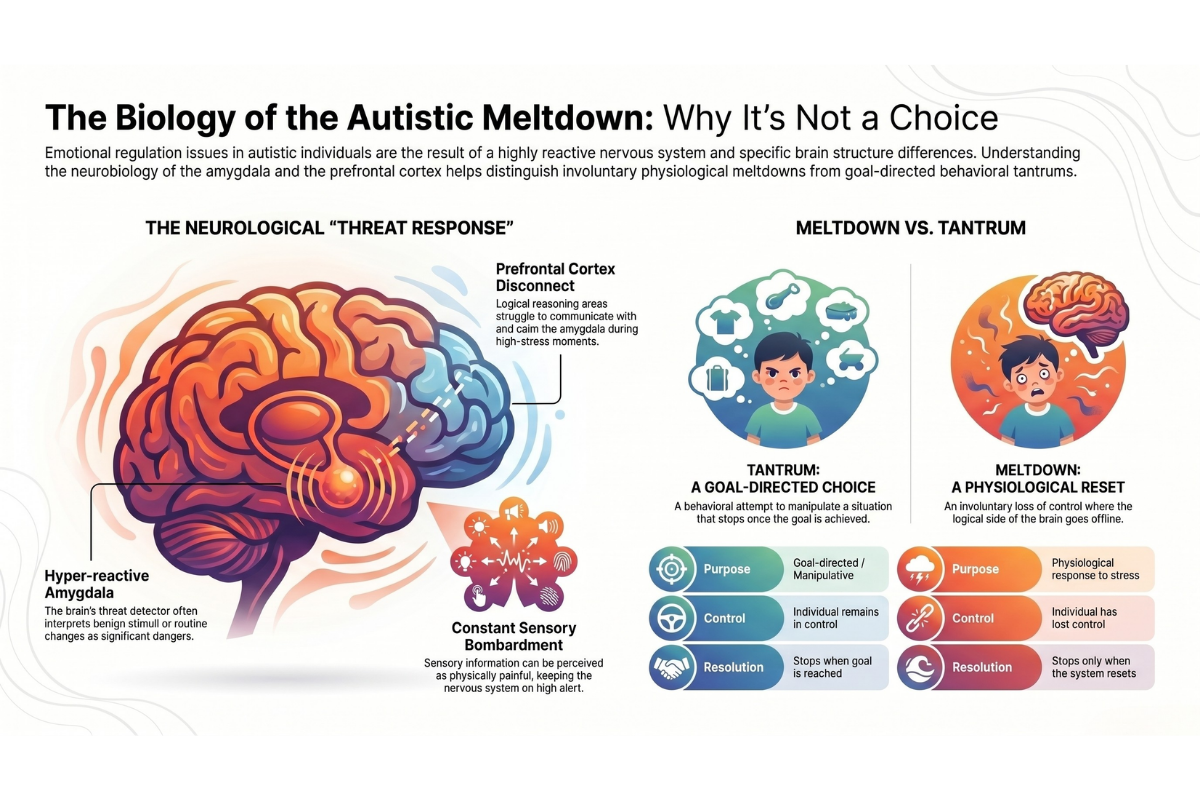
To understand emotional dysregulation, we must look at the brain. The amygdala, a small almond-shaped structure deep in the brain, acts as the body’s threat detector. It is responsible for processing emotions, particularly fear and anxiety, and triggering the “fight or flight” response.
Studies published in the National Library of Medicine suggest that the amygdala in autistic individuals often functions differently. It may be hyper-reactive, interpreting benign stimuli (like a loud noise or a change in plans) as significant threats. This means the autistic brain is frequently flooded with stress hormones, even in objectively safe environments.
Furthermore, the connections between the amygdala and the prefrontal cortex (the area of the brain responsible for logical reasoning and impulse control) may be less efficient. When the amygdala sounds the alarm, the prefrontal cortex struggles to step in and calm the system down. This neurological reality explains why simply telling an autistic person to “calm down” is ineffective; their brain is actively signaling that they are in danger.
Meltdowns vs. Tantrums: Understanding the Difference
One of the most damaging misconceptions about autism is the conflation of meltdowns and tantrums. Understanding the difference is crucial for providing effective support.
A tantrum is a goal-directed behavior. It is an attempt to manipulate a situation to get a desired outcome (e.g., crying to get a toy). Once the goal is achieved, or the person realizes the behavior will not work, the tantrum stops. The individual remains in control of their actions.
A meltdown is a physiological response to overwhelming stress. It is not goal-directed, and it is not manipulative. As noted by the Association for Autism and Neurodiversity (AANE), when an autistic person is in a meltdown, they have lost access to the logical side of their brain. Executive functioning is offline. The individual is entirely overwhelmed by sensory or emotional input and has lost control of their behavioral response.
| Feature | Tantrum | Meltdown |
|---|---|---|
| Purpose | Goal-directed (to get something or avoid something). | No purpose; a reaction to overwhelming stress. |
| Control | The individual is in control and monitoring the audience. | The individual has lost control; the audience is irrelevant. |
| Resolution | Ends when the goal is met or the strategy fails. | Ends only when the nervous system has exhausted its energy or the overwhelming stimuli are removed. |
| Aftermath | Quick recovery, often returning to normal activity immediately. | Exhaustion, shame, and a need for significant recovery time. |
Responding to a meltdown requires removing demands, reducing sensory input, and ensuring physical safety. It is not a time for teaching or discipline.
Shutdowns: The Freeze Response
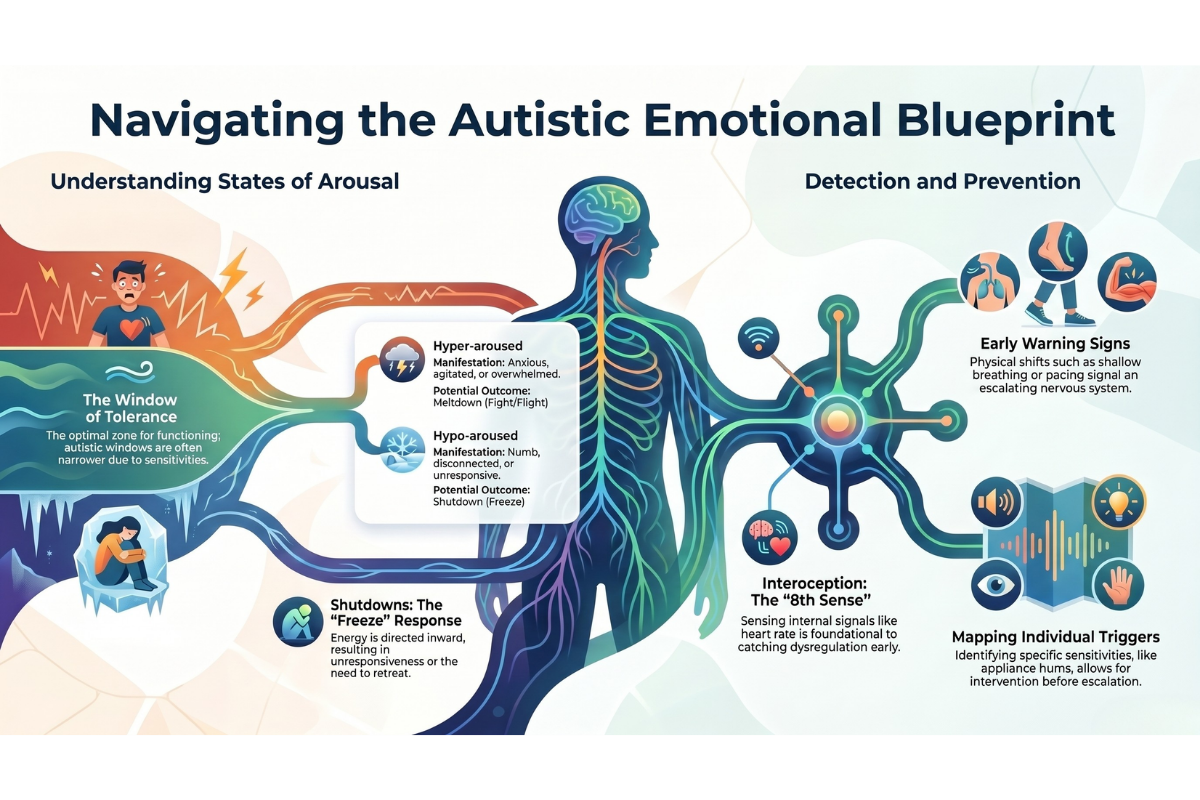
While meltdowns are external and explosive (the “fight or flight” response), shutdowns are internal and implosive (the “freeze” response).
During a shutdown, the nervous system is equally overwhelmed, but the energy is directed inward. The individual may become completely unresponsive, unable to speak, move, or process information. They might stare blankly, retreat to a dark room, or appear to be sleeping.
Shutdowns are often misunderstood as defiance or laziness. In reality, they are a profound state of physiological exhaustion. The brain has essentially pulled the plug to protect itself from further damage. Recovery from a shutdown requires time, quiet, and a complete absence of demands.
Identifying Personal Triggers and Early Warning Signs
The key to managing meltdowns and shutdowns is preventing them. This requires identifying personal triggers and recognizing the early warning signs of dysregulation.
Triggers are highly individualized. For one person, it might be the hum of a refrigerator; for another, it might be an unexpected change in schedule or a vague social expectation.
Early warning signs are the physical and behavioral cues that indicate the nervous system is beginning to escalate. These might include:
- Increased pacing or stimming (self-stimulatory behavior)
- Changes in breathing patterns (shallow or rapid breathing)
- Difficulty finding words or a sudden drop in vocal volume
- Increased sensitivity to light or sound
- A feeling of tightness in the chest or stomach
By mapping these triggers and warning signs, autistic adults can intervene before the escalation reaches a point of no return.
The Window of Tolerance: Staying Regulated
The “window of tolerance” is a concept used to describe the optimal zone of arousal where a person can function effectively. When you are within your window of tolerance, you can process information, manage emotions, and engage socially.
When stress pushes you outside this window, you enter a state of dysregulation. You might become hyper-aroused (anxious, agitated, heading toward a meltdown) or hypo-aroused (numb, disconnected, heading toward a shutdown).
Autistic individuals often have a narrower window of tolerance due to sensory sensitivities and neurological differences. The goal of emotional regulation strategies is not to eliminate stress, but to widen the window of tolerance and develop tools to return to it when pushed outside.
The Role of Body Awareness in Emotional Regulation (Interoception)
You cannot regulate what you cannot feel. This is where interoception comes in. Interoception is the eighth sensory system; it is the ability to perceive internal bodily sensations, such as hunger, thirst, heart rate, and muscle tension.
Research indicates that many autistic individuals experience interoceptive differences. They may have difficulty sensing when their heart rate is increasing or when their muscles are tense. Without these internal cues, they may not realize they are becoming dysregulated until they are already in a meltdown or shutdown.
Improving interoceptive awareness is a foundational step in emotional regulation. By learning to tune into the body’s signals, autistic adults can catch dysregulation early.
Self-Regulation Strategies: Sensory Tools, Movement, and Grounding
Effective self-regulation strategies must be personalized. What works for one person may be overwhelming for another. However, most successful strategies fall into a few key categories:
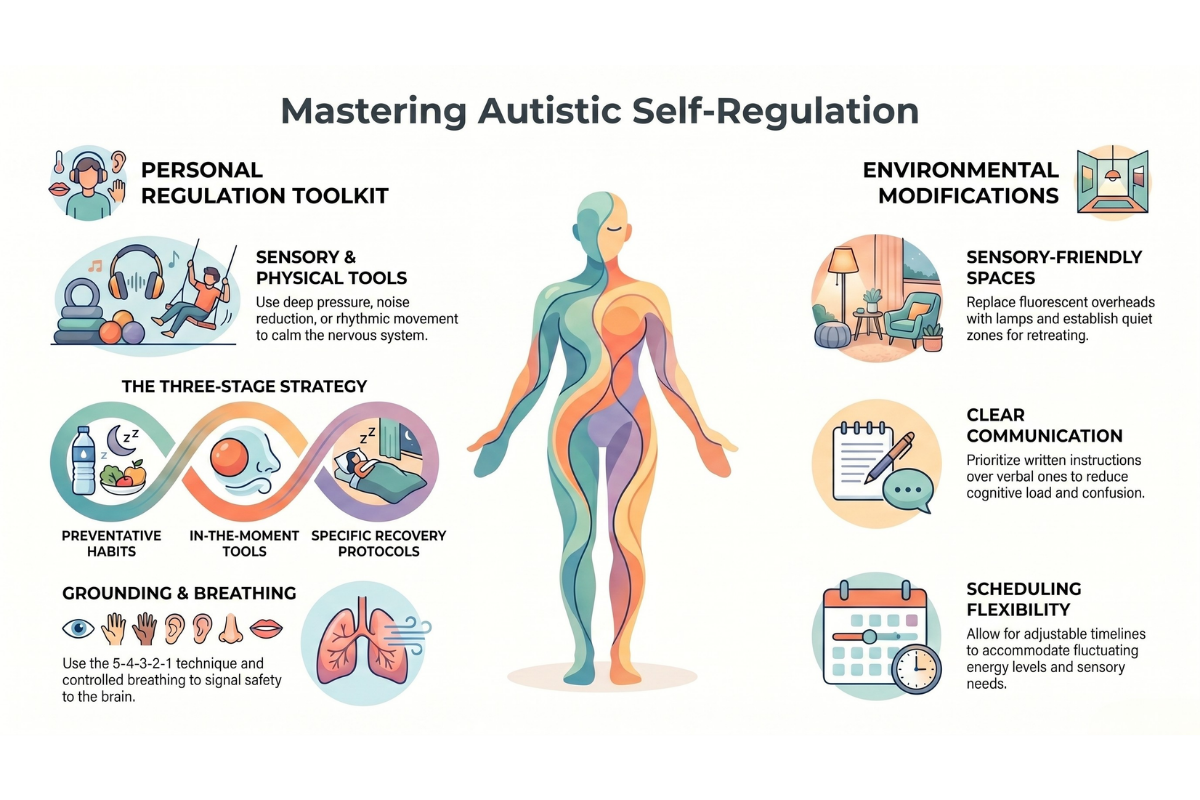
- Sensory Tools: Using sensory input to calm the nervous system. This might include weighted blankets (deep pressure), noise-canceling headphones (reducing auditory input), or chewelry (oral input).
- Movement: Physical activity helps process stress hormones. This can range from intense exercise (running, lifting weights) to rhythmic, repetitive movements (rocking, swinging).
- Grounding Techniques: Strategies that bring the focus back to the present moment. The 5-4-3-2-1 technique (identifying five things you can see, four you can touch, etc.) is a common example.
- Breathing: Controlled breathing directly impacts the autonomic nervous system, signaling the brain that it is safe to relax.
How Therapeutic Movement Builds Regulation Capacity
Therapeutic Movement is a powerful tool for building emotional regulation capacity. It bridges the gap between physical sensation and emotional awareness. And at Meristem, it is woven into the fabric of every week.
On the 13-acre Meristem campus, movement is not a break from learning; it is the learning. Students roller skate, take structured nature walks, swim, and work out in the gym. These are not recreational extras. They are deliberate, body-based practices that help students develop proprioception (awareness of the body in space) and interoception. By engaging in mindful, purposeful movement, students learn to recognize where they hold tension, how their breathing changes under stress, and what their body needs to return to calm.
The physical demands of the campus itself are part of the design. Working on the three-acre organic farm — hauling compost, tending crops, caring for chickens — requires sustained physical effort and attentiveness to the body’s signals. Students who spend time on the farm regularly report a grounded, settled quality to their mood afterward. That is not coincidence. Physical labor in a natural environment is one of the most effective nervous system regulators available.
Then there are the field trips. American River rafting. Hiking at Soda Springs Snow Park. Navigating Black Chasm Caves. These are not just fun outings; they are high-stakes, sensory-rich environments where students must regulate in real time, without the safety net of a familiar space. The staff at Meristem are trained to support students through these moments, helping them apply their toolkits when it matters most. Over time, the body awareness gained through these experiences translates into better emotional awareness, widening the window of tolerance in ways that a classroom exercise never could.
Creating a Regulation Toolkit
Every autistic adult needs a personalized regulation toolkit. This is a collection of strategies, objects, and environments that they know will help them return to their window of tolerance.
A comprehensive toolkit should include:
- Preventative Strategies: Routines and habits that maintain baseline regulation (e.g., getting enough sleep, scheduling downtime after social events).
- In-the-Moment Tools: Strategies to use when early warning signs appear (e.g., stepping outside, using a fidget toy, deep breathing).
- Recovery Protocols: A plan for what to do after a meltdown or shutdown (e.g., resting in a dark room, engaging in a special interest, avoiding demands).
The toolkit should be created during a time of calm, not during a crisis.
Environmental Modifications That Support Regulation
Emotional regulation is not solely the responsibility of the autistic individual. The environment plays a massive role. Modifying the environment to reduce unnecessary stressors is often the most effective intervention.
This might involve:
- Adjusting lighting (using lamps instead of overhead fluorescent lights)
- Creating quiet zones where the individual can retreat without explanation
- Providing clear, written instructions rather than relying on verbal communication
- Allowing flexibility in scheduling to accommodate fluctuating energy levels
When the environment is supportive, the individual has more energy available for actual regulation.
How Programs Teach Regulation Through Experience
Effective transition programs do not just talk about emotional regulation; they provide opportunities to practice it in real-world settings. That distinction matters enormously.
At Meristem, regulation is not a class on the schedule. It is a byproduct of everything on the schedule. Consider the culinary kitchen. The heat of the stove, the timing of multiple orders, the noise of a busy service — these are genuine sensory and cognitive stressors. Students cannot opt out of them. They have to manage them. And in managing them, week after week, they build real regulation capacity.
The same is true of the Meristem Café, Meristem’s student-run social enterprise. In 2025, students completed 564 café shifts, serving community members who came specifically because of the quality of the experience. That is not a simulation. That is real-world pressure, with real-world stakes, and students navigating it in real time.
Meristem’s approach is grounded in a philosophy they call “Meeting Resistance.” The idea is straightforward: confidence and regulation capacity are not built by avoiding hard things. They are built by moving through them, with the right support alongside you. When clay does not cooperate in the art studio, when a recipe fails in the kitchen, when a social interaction goes sideways on a field trip — those are not setbacks. They are the curriculum.
Staff are trained to recognize early warning signs of dysregulation and to support students in using their toolkits in the moment, not after the fact. This is the difference between teaching regulation as a concept and teaching it as a lived practice.
Success Stories: From Dysregulation to Self-Management
The journey from chronic dysregulation to self-management is real, and Meristem’s 2025 Impact Report puts a face to it.
Abbie has been part of the Meristem community for years. She started in the Day Program, and when the opportunity came to move into the residential dorms, she took it — even though the first attempt did not go as planned. She tried again. That decision alone says something important about what Meristem builds in its students.
When Abbie first moved into the dorms, everyday tasks that most people take for granted were significant hurdles. Completing a laundry cycle without restarting it. Getting through a checkout line without freezing. These are not small things. They are moments where the nervous system either holds or breaks down, and for Abbie, they were breaking points.
Today, Abbie completes her laundry independently. She engages confidently with cashiers and bags her own groceries. More importantly, she recognizes when her anxiety is rising — and she knows what to do about it. She can manage her time and her emotions without a staff member nearby. That is not just a life skill. That is self-regulation, built through thousands of small moments of practice in a campus environment designed to make those moments possible.
The Meristem 2025 Impact Report describes the goal as “inner confidence that helps young adults navigate real life with stability and dignity.” Abbie’s story is what that looks like in practice.
Conclusion: Working With the Nervous System
Autism emotional regulation requires a shift in perspective. We must stop viewing meltdowns and shutdowns as behavioral problems to be fixed, and start viewing them as physiological responses to be understood. By validating the autistic experience, improving interoceptive awareness, and building personalized toolkits, we can empower autistic adults to navigate the world with resilience and confidence.
Regulation is a skill, and like any skill, it takes practice. But with the right support, it is entirely achievable.
Ready to explore body-based regulation strategies? Learn more about
how our Therapeutic Movement program helps students build interoception and emotional resilience, or discover the grounding effects of our Land & Nature Immersion activities.
Voices of Community Podcast
Join us for conversations with autistic adults, families, and professionals who are helping shape a more inclusive world. Each episode shares personal stories, insights, and perspectives from across the Meristem community and beyond.
Sign Up for Our Newsletter

See the impact for yourself. Our 2025 Impact Report shares real outcomes. Employment, independence, and the milestones our students are reaching. Get your free copy below.