Audio Overview
Key Takeaways: The Anatomy of Movement
This post, featuring insights from Meristem’s Executive Director, Erin Schirm, explores the concept of “movement” as a tool for personal growth. Movement isn’t just physical; it’s any shift in our physical, emotional, or mental state. By becoming aware of our patterns of movement, we can learn to break free from being “stuck” and intentionally choose how we show up in the world.
The 3-Step Practice for This Week:
- The Concept: Movement. Recognize that movement is happening all the time—in your body, your feelings, and your thoughts. The goal is to become a conscious observer of this constant state of change.
- The Practice: Presence. The first step to changing your patterns is awareness. This week’s practice is to simply observe your own patterns of physical, emotional, and mental movement without judgment.
- The Value: I Show Up (Dignity). Ground your practice in the value of showing up with intention. Are your movements conscious and deliberate, or are you just going through the motions? This value calls us to bring dignity to ourselves and others by being fully present.
Stuck in a Rut? The Surprising Power of Movement to Change Your Mind
We’ve all been there. Stuck in a thought loop we can’t escape. Stuck in an emotional state that colors our entire day. Stuck in physical habits that we perform on autopilot. This feeling of being “stuck” is one of the most common barriers to personal growth. But what if the solution was simpler than we think? What if the key to changing your mind was to change your position?
At Meristem, we explore this idea through a broad and powerful definition of the word movement. It’s a core concept in our weekly practice, a framework we use to build self-awareness and create intentional change. As our Executive Director explains in this week’s video, movement is not just a physical action; it is any shift in our state of being.
The Three Realms of Movement
The word “movement” has evolved. It once referred only to an observable change in physical position, like a hand moving from one place to another. But we now understand that movement happens across three interconnected realms of our being:
- Physical Movement: The most obvious form. A change in posture, a walk across the room, the act of turning your head.
- Emotional Movement: A shift in your internal feeling state. Moving from happy to sad, from calm to anxious, from frustrated to content.
- Mental Movement: A change in your thoughts or perspective. Realizing you like a food you thought you hated, understanding someone else’s point of view, or having a sudden insight.
Recognizing that these three realms are constantly in motion is the first step. The next is understanding that they are deeply connected. Research from the American Psychological Association shows that physical movement has a direct impact on mental health and emotional regulation. As we say at Meristem, if you want to see a change in your mental or emotional state, you often need to start by moving differently.
This Week’s Practice: Observing Your Patterns
This week, we invite you to join us in our 3-step practice, using the framework we introduced in our first post on self-reflection. The goal this week is not to change anything, but simply to become aware.
Step 1: The Concept – Movement
Your task this week is to become a student of movement. See it everywhere. Notice the subtle shifts in your own state and the states of those around you. How does a change in your posture affect your mood? How does a new piece of information change your perspective? How does a strong emotion manifest as a physical sensation in your body?
| Type of Movement | Column 2 |
|---|---|
| Physical | Shifting in your chair, tapping your foot, walking to the kitchen. |
| Emotional | Feeling a wave of frustration after a difficult email, then a sense of relief after a good conversation. |
| Mental | Changing your opinion on a topic after learning new information. |
Step 2: The Practice – Presence
Awareness is the gateway to change. You cannot change a pattern you do not know you have. This week’s practice is Presence: the act of intentionally observing your own patterns of physical, emotional, and mental movement.
- Set an Intention: A few times each day, simply pause and ask yourself: “What is my physical state right now? What is my emotional state? What thoughts are running through my head?”
- Observe Without Judgment: This is the most crucial part. The goal is not to label your patterns as “good” or “bad.” The goal is simply to notice them. “I notice that when I feel anxious, I tend to pace around the room.” “I notice that I have the same negative thought every time I start a new project.”
- Be Courageous: It takes courage to look at ourselves honestly. This practice is not about finding flaws; it’s about gathering information. It’s about getting to know yourself on a deeper level.
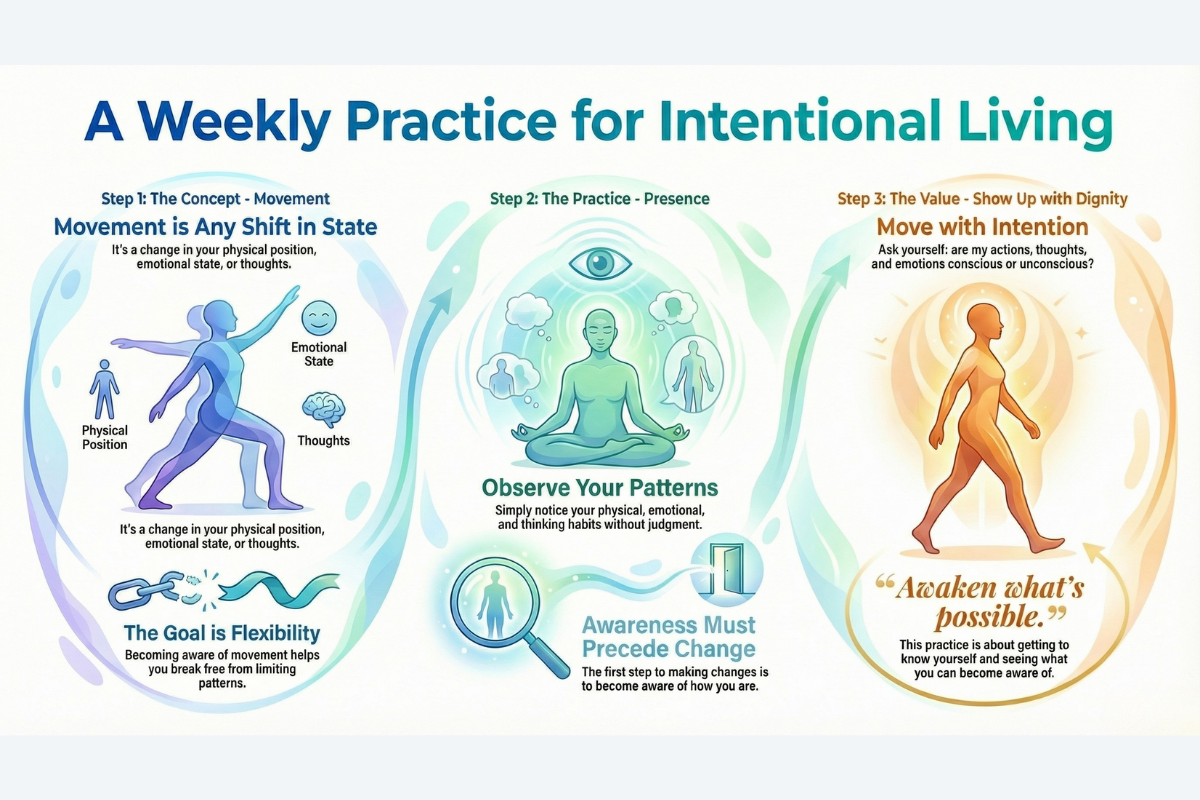
Step 3: The Value – I Show Up (Dignity)
Finally, we ground this practice in one of Meristem’s core values: “I Show Up,” which is linked to the concept of Dignity.
Showing up is not just about being physically present. It’s about the quality of that presence. This value asks us: What movements are you showing up with?
- Conscious vs. Unconscious Movement: Are you showing up with conscious, intentional movements, or are you just going through the motions? Are you actively responding to the environment, or are you being driven by unconscious habits?
- Bringing Dignity to Interactions: To show up with dignity for yourself and others means bringing awareness to your movements. For example:
- Mental Movement: If you are in a conversation with someone who has an opposing viewpoint, can you consciously move your perspective to try to understand theirs?
- Physical Movement: Do you have a pattern of standing too close to people? Can you become aware of that and show up differently, respecting their personal space?
- Emotional Movement: Are you showing up to a meeting with frustration from a previous interaction? Can you become aware of that and choose to bring a different emotional energy to the new situation?
Practicing this value is about asking how much consciousness you can bring to the way you show up in the world. It’s the difference between being a passenger in your own life and being the driver.
Conclusion: The First Step is Awareness
This week’s practice is simple, but it is not easy. It is the foundational work of all personal growth. By taking the concept of Movement, engaging in the practice of Presence, and living the value of Showing Up, you are building the self-awareness necessary to create lasting change.
As we say at Meristem, Awaken the Possible. Don’t try to do more than that. Just see what’s possible to become aware of and to wake up to.
It starts with you.
Anatomy of Growth Video Series
Join Meristem’s Executive Director, Erin Schirm, as he breaks down the concepts, practices, and values that drive personal transformation. Each video offers a practical framework you can apply to your own life—from self-reflection to movement to communication. Discover how growth really works, one insight at a time. It starts with you.