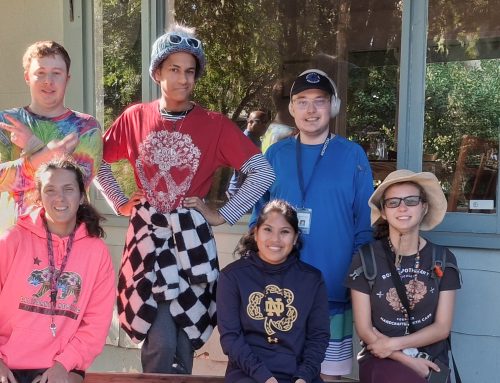
How do we help autistic young adults build the social skills and emotional regulation necessary for meaningful connection and lasting confidence? Autism social development does not happen by accident, and it does not happen by forcing young people to act neurotypical. It happens when autistic young adults are supported in environments that honor how they actually learn; through shared experience, structured practice, and genuine belonging. The most effective approaches move through three stages of social growth: building self-awareness, fostering interpersonal connection, and developing a shared community vision. When those stages are supported well, the results are real and lasting.
The transition to adulthood is a profound shift for any young person. For autistic young adults, this period often brings a unique set of social and emotional challenges. As the structured environment of high school fades away, the demand for independent social navigation increases dramatically. Suddenly, the expectations for communication, relationship building, and emotional self-management become more complex and less forgiving. This is a critical juncture. Without the right support, many autistic young adults face significant isolation. With the right support, however, they can develop the social agency and emotional resilience needed to thrive.
This comprehensive guide explores the intricacies of autism social development. We will examine why social skills do not always develop “naturally” for autistic individuals, the vital role of emotional regulation, and the evidence-based strategies that foster genuine connection and self-acceptance.
The Social and Emotional Challenges of Autism
The core characteristics of autism spectrum disorder (ASD) inherently impact social communication and interaction. According to the Centers for Disease Control and Prevention (CDC), ASD is a developmental disability that can cause significant social, communication, and behavioral challenges [1]. For teenagers and young adults, these challenges often become more pronounced as peer relationships grow more nuanced and the social landscape becomes less structured.
Research highlights a stark reality regarding social participation among this demographic. A pivotal study published by the National Institutes of Health (NIH) found that young adults with ASD were significantly more likely to experience social isolation compared to their peers with other disabilities [2]. The data is sobering: nearly 40% of youth with ASD spend little or no time with friends outside of school or structured activities [1] [2]. This isolation is not typically a choice; it is often the result of a mismatch between the individual’s social processing style and the expectations of the neurotypical world.
Furthermore, emotional regulation – the ability to manage and respond to an emotional experience – is frequently compromised in autistic individuals. A comprehensive review in the Journal of the American Academy of Child & Adolescent Psychiatry notes that ASD is associated with amplified emotional responses and poor emotional control [3]. This emotional dysregulation can manifest as intense anxiety, frustration, or what are colloquially known as “meltdowns.” These reactions are not behavioral defiance; they are physiological responses to overwhelming sensory or emotional input.
When an individual is constantly expending energy just to manage their sensory environment, they have fewer cognitive resources available to process complex emotions or navigate social interactions. This creates a compounding effect. The sensory overwhelm leads to emotional dysregulation, which in turn makes social interaction more difficult, leading to further isolation. Breaking this cycle requires a deep understanding of how these elements intersect.
Why Social Skills Don’t Develop “Naturally” for Many Autistic Individuals
In neurotypical development, social skills are often acquired implicitly. Children observe, mimic, and internalize the “rules” of social engagement without direct instruction. They naturally pick up on the subtle cues of body language, tone of voice, and conversational timing. For many autistic individuals, this implicit learning process is disrupted.
Autism Speaks notes that for people with autism, it can be harder to learn and build up these skills, forcing them to guess what the social “map” should look like [4]. They may struggle to interpret nonverbal communication, understand abstract social concepts, or navigate the unwritten rules of social interaction. This does not mean they lack the desire for connection. On the contrary, many autistic young adults deeply crave friendship and belonging. The barrier is not a lack of interest, but a lack of the specific, explicit tools needed to bridge the communication gap.
When social skills do not develop naturally, they must be taught intentionally. However, traditional methods of social skills training – such as sitting in a classroom and discussing hypothetical scenarios – often fall short. Autistic learners typically require direct, explicit instruction combined with opportunities to practice in realistic, supported settings [4]. They need to experience the social interaction, reflect on it, and adjust their approach in real-time.
This is a crucial distinction. We cannot simply tell an autistic young adult how to make a friend and expect them to execute it flawlessly in a high-pressure social environment. We must provide the scaffolding. We must break down the complex dance of human interaction into manageable, understandable steps, and then provide a safe space for them to practice those steps without fear of judgment or rejection.
The Three Stages of Social Growth: Awareness, Connection, and Vision
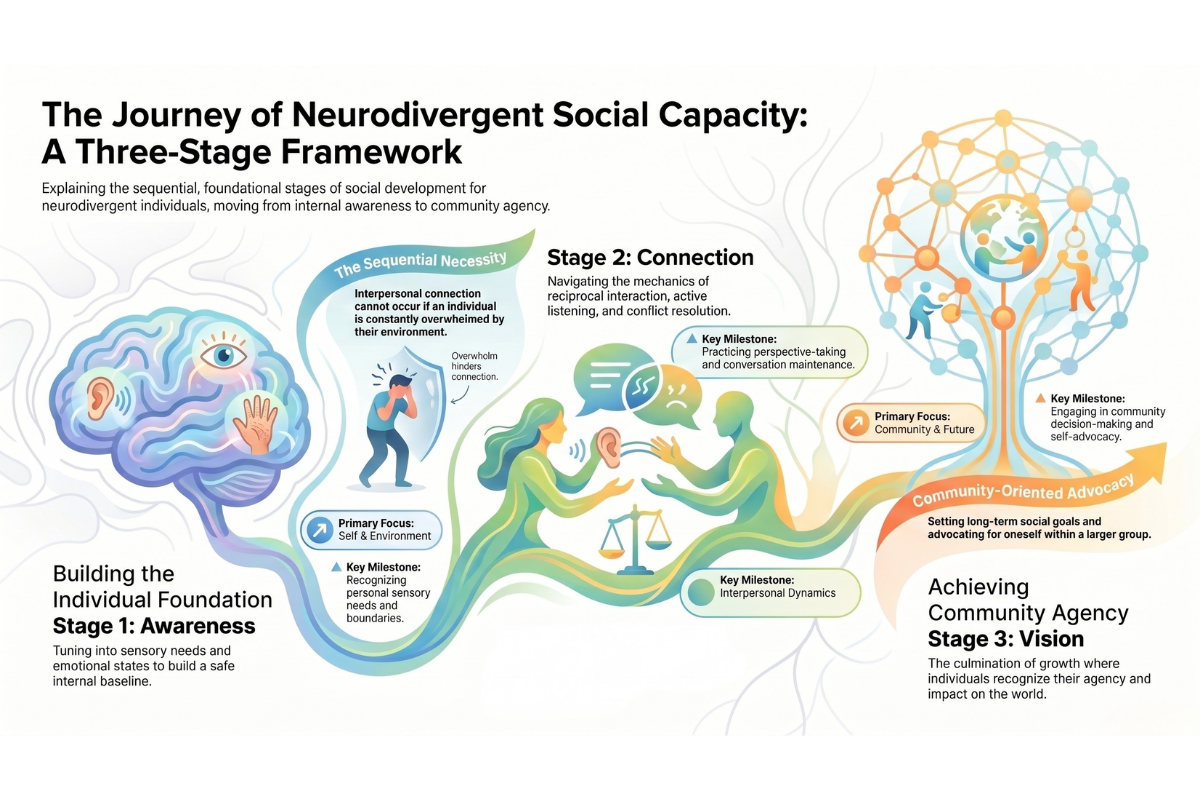
Building social capacity is not a linear process, nor is it a switch that can simply be flipped. Autism social development is a journey that requires patience, structured support, and a deep understanding of the individual’s unique neurocognitive profile. At Meristem, we conceptualize this journey through three distinct stages of social growth.
| Stage of Growth | Focus Area | Key Developmental Milestones |
|---|---|---|
| 1. Awareness | Self and Environment | Recognizing personal sensory needs; identifying emotional states; understanding personal boundaries; developing basic body awareness in space. |
| 2. Connection | Interpersonal Dynamics | Initiating and maintaining conversations; recognizing the perspectives of others; practicing active listening; navigating conflict resolution. |
| 3. Vision | Community and Future | Understanding one’s role within a larger group; setting long-term social goals; engaging in community-oriented decision making; advocating for self and others. |
These stages provide a framework for understanding where an individual currently stands and what supports they need to progress. A young adult cannot effectively navigate complex interpersonal dynamics (Connection) if they are constantly overwhelmed by their sensory environment and unable to identify their own emotional state (Awareness). By addressing these stages sequentially, we build a solid foundation for lasting social competence.
The Awareness stage is often the most intensive. It requires unlearning years of masking and learning to tune into the body’s signals. Only when an individual feels safe and grounded in their own body can they begin to extend their awareness outward to others. The Connection stage builds upon this foundation, introducing the mechanics of reciprocal interaction. Finally, the Vision stage represents the culmination of this work, where the individual recognizes their own agency and their capacity to impact the world around them.
Social Growth Progression: From Common Interest to Common Vision
Within the stages of social growth, the actual mechanics of building relationships follow a specific progression. For autistic young adults, moving from isolation to deep friendship requires structured stepping stones. We observe this progression moving through four distinct phases.
- Common Interest: This is the entry point. Friendships often begin around a shared passion or circumscribed interest. Whether it is a specific video game, a genre of literature, or a technical skill like woodworking, the shared interest provides a safe, predictable topic of conversation. It reduces the cognitive load of having to generate “small talk” and allows individuals to connect over a known subject.
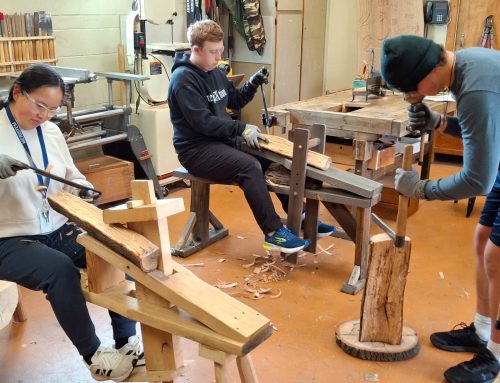
- Common Direction: Once a connection is established around an interest, the relationship can move toward a shared activity or goal. This might involve collaborating on a project in the Meristem woodshop or working together in the culinary arts program. The focus shifts from simply talking about the interest to actively engaging in it together. This requires negotiation, turn-taking, and shared attention.
- Common Experience: As individuals spend more time working in a common direction, they begin to build a shared history. They navigate challenges together, celebrate successes, and develop inside jokes or shared routines. This common experience deepens the bond and creates a sense of mutual reliance. The relationship becomes less about the initial interest and more about the connection itself.
- Common Vision: The deepest level of connection occurs when individuals share a broader vision for their community or their future. This involves a high degree of empathy, mutual respect, and social agency. They are no longer just friends who share an interest; they are partners who support each other’s growth and advocate for their shared values.
This progression highlights the importance of providing autistic young adults with environments where they can discover shared interests and engage in collaborative, meaningful work. It is through these shared experiences that genuine, lasting friendships are forged. We cannot force connection, but we can cultivate the soil in which it grows.
Emotional Regulation and Sensory Processing
Emotional regulation is inextricably linked to sensory processing for many autistic individuals. The world is often experienced at a higher volume, with brighter lights, sharper textures, and more chaotic sounds than neurotypical individuals perceive. When the sensory input becomes overwhelming, the nervous system’s ability to regulate emotion is severely compromised.
Research indicates that inadequate emotion regulation strategies are prevalent in ASD [3]. Autistic adults often report using less cognitive reappraisal (changing how one thinks about a situation to alter its emotional impact) and experiencing higher levels of emotional dysregulation [3]. This dysregulation is not a character flaw; it is a neurological reality. When an individual is constantly expending energy just to manage their sensory environment, they have fewer cognitive resources available to process complex emotions or navigate social interactions.
To support emotional regulation, we must first address sensory needs. This involves creating environments that minimize unnecessary sensory stressors and teaching individuals how to recognize their own signs of sensory overload. It also requires moving away from behavioral compliance models that punish emotional outbursts, and instead adopting compassionate approaches that seek to understand the root cause of the distress. As noted by the Association for Autism and Neurodiversity (AANE), the keys to supporting autistic adults with emotional regulation are empathy, patience, and collaboration [5].
We must recognize that a “meltdown” is not a tantrum. It is a system failure caused by overload. When we shift our perspective from behavior management to nervous system support, we change the entire trajectory of an individual’s emotional development. We move from demanding compliance to fostering resilience.
Building Self-Awareness and Self-Acceptance
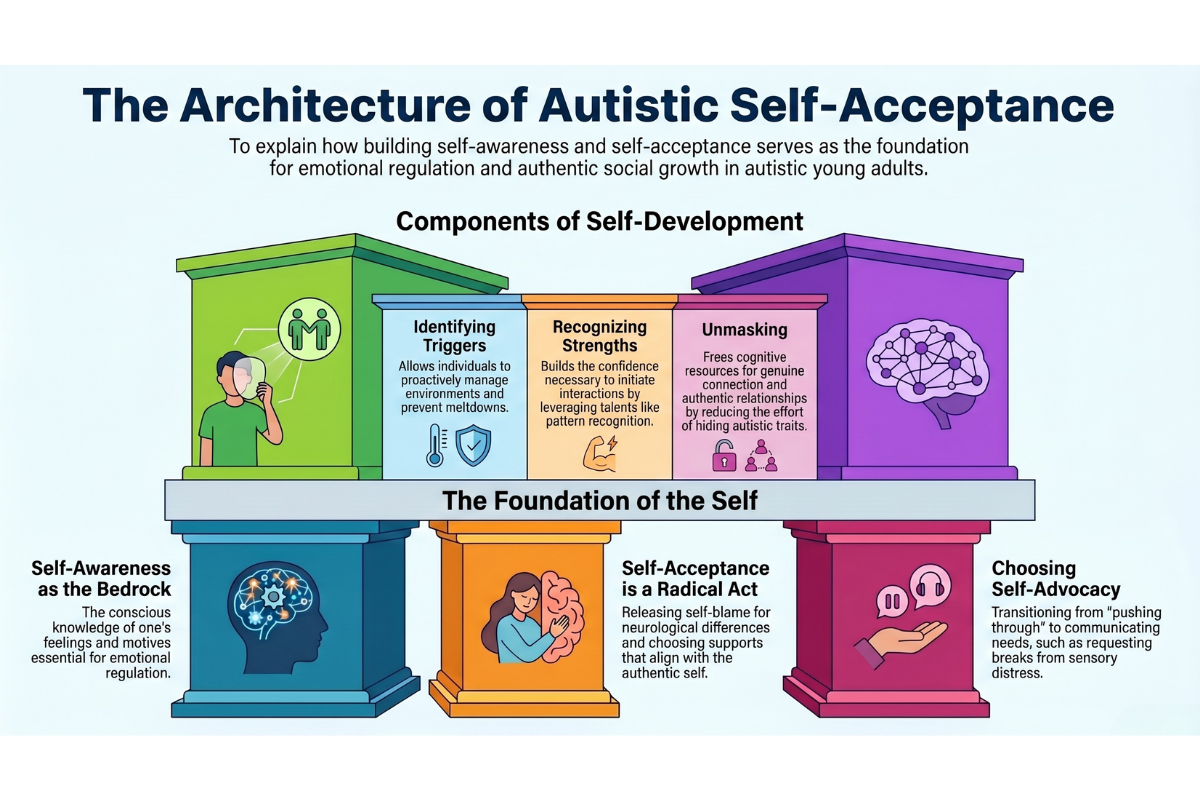
Before an autistic young adult can effectively connect with others, they must first connect with themselves. Self-awareness – the conscious knowledge of one’s own character, feelings, motives, and desires – is the bedrock of emotional regulation and social growth. However, for individuals who have spent their lives being told that their natural ways of moving, communicating, and processing the world are “wrong,” developing a healthy sense of self-awareness can be incredibly difficult.
This is where self-acceptance becomes crucial. Autistic self-advocates emphasize that self-acceptance is a radical act [6]. It means honoring one’s own needs, releasing self-blame for neurological differences, and choosing supports that align with one’s authentic self, rather than striving to appear neurotypical.
| Component of Self-Development | Description | Impact on Social Growth |
|---|---|---|
| Identifying Triggers | Recognizing specific sensory inputs, social situations, or cognitive demands that cause distress. | Allows the individual to proactively manage their environment and communicate their needs to others, preventing meltdowns and preserving social energy. |
| Recognizing Strengths | Acknowledging personal talents, deep interests, and unique cognitive abilities (e.g., attention to detail, pattern recognition). | Builds the confidence necessary to initiate social interactions and contribute meaningfully to group projects or employment settings. |
| Unmasking | Reducing the exhausting effort of hiding autistic traits (like stimming or avoiding eye contact) to appear neurotypical. | Frees up cognitive resources for genuine connection and allows for the development of authentic relationships based on mutual acceptance. |
Building self-awareness is an ongoing process. It requires safe spaces where individuals can explore their identities without judgment. When an autistic young adult understands their own neurological profile and accepts it without shame, they are far better equipped to navigate the social world with confidence. They learn to say, “I need a break from this noise,” rather than pushing through until they collapse. That self-advocacy is the ultimate expression of self-awareness.
The Role of Body Awareness in Emotional Regulation (Therapeutic Movement)
One of the most effective, yet often overlooked, tools for building self-awareness and emotional regulation is therapeutic movement. The mind and the body are not separate entities; they are deeply interconnected. For many autistic individuals, the physical experience of emotion can be confusing or overwhelming. They may struggle with interoception – the ability to perceive internal bodily sensations, such as a racing heart or tense muscles, which are the early warning signs of emotional dysregulation.
Therapeutic movement programs, such as those offered at Meristem, focus on building body awareness and coordination. By engaging in intentional physical activities—whether it is roller skating, nature walks, or structured gym exercises – students learn to understand how their bodies move through space. This physical grounding translates directly into emotional grounding.
When an individual develops better physical stamina and coordination, they also develop a greater capacity for nervous system regulation. They learn to recognize the physical signs of stress and employ movement-based techniques to return to a state of calm. This is not about physical fitness in the traditional sense; it is about using the body as an anchor to stabilize the mind. As students gain physical confidence, that confidence naturally bleeds into their social interactions. They stand taller, they occupy space more comfortably, and they are less easily overwhelmed by the physical proximity of others.
Friendship Development: From Isolation to Connection
The statistics regarding social isolation among autistic young adults are daunting, but they are not destiny. Friendship development is entirely possible when the right supports and environments are in place. However, the approach must be tailored to the neurodivergent experience.
Traditional advice for making friends, such as “just put yourself out there” or “make small talk”, is often ineffective and anxiety-inducing for autistic individuals. Instead, friendship development should be facilitated through structured, shared activities. As discussed in the progression of social growth, common interests provide the necessary scaffolding for connection.
Furthermore, it is essential to recognize the value of different types of social connections. Recent research suggests that “weak-tie” interactions – casual, low-pressure interactions with acquaintances or community members – can be highly beneficial for autistic people [7]. These interactions provide a sense of belonging and social practice without the intense demands of close, intimate friendships.
To move from isolation to connection, programs must provide opportunities for both structured collaboration and low-pressure socialization. This might look like working together in a community garden, participating in a specialized social skills group, or simply sharing a meal in a supportive environment like the Meristem Café. The goal is to create a community where neurodiversity is the norm, and where individuals can practice social skills without fear of rejection. It is about creating a micro-society where the rules of engagement are clear, supportive, and designed for success.
Social Agency: Community-Oriented Decision Making
As autistic young adults progress through the stages of social growth, the ultimate goal is the development of social agency. Social agency goes beyond simply participating in a group; it involves actively shaping that group and making decisions that impact the community. It is the shift from being a passive recipient of services to being an active contributor to society.
Developing social agency requires opportunities for leadership and collaboration. It means giving young adults a voice in how their programs are run, allowing them to plan events, and encouraging them to advocate for their needs and the needs of their peers. When individuals feel that their contributions matter and that their voices are heard, their confidence grows exponentially.
This community-oriented decision making is a core component of the Meristem Method. By engaging in social enterprises, such as the Herbal Arts program or the campus café, students are not just learning job skills; they are learning how their work impacts others. They see the direct results of their efforts in the satisfaction of a customer or the success of a team project. This tangible evidence of their own competence is far more powerful than any verbal praise. It proves to them, unequivocally, that they have value and agency in the world.
The Hidden Curriculum of Social Interaction
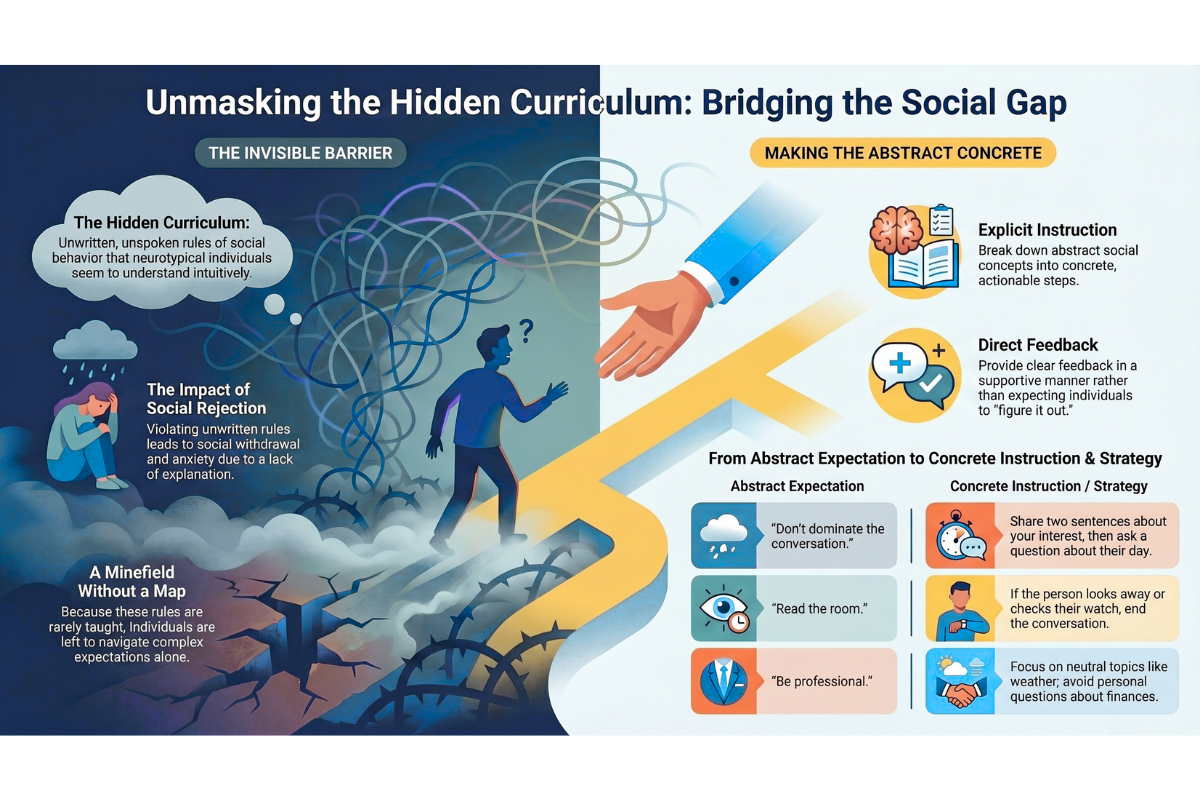
One of the most significant barriers to social integration for autistic individuals is the “hidden curriculum.” This term refers to the unwritten, unspoken rules of social behavior that neurotypical individuals seem to understand intuitively. It includes everything from knowing how close to stand to someone in an elevator, to understanding the subtle difference between a friendly tease and an insult, to knowing when it is appropriate to interrupt a conversation.
Because these rules are rarely explicitly taught, autistic individuals are often left to navigate a minefield of social expectations without a map. When they inevitably violate an unwritten rule, they may face social rejection or reprimand without understanding what they did wrong. This repeated experience of failure without explanation is a primary driver of social anxiety and withdrawal.
To support autism social development, we must make the hidden curriculum explicit. This involves breaking down abstract social concepts into concrete, actionable steps. It means providing clear, direct feedback in a supportive manner, rather than expecting individuals to simply “figure it out.”
| Element of the Hidden Curriculum | Abstract Expectation | Concrete Instruction / Strategy |
|---|---|---|
| Conversational Turn-Taking | “Don’t dominate the conversation.” | “After you share two sentences about your interest, ask the other person a question about their day.” |
| Reading the Room | “Pay attention to how others are feeling.” | “Look at the person’s face. If they are looking away or checking their watch, it is time to change the topic or end the conversation.” |
| Workplace Boundaries | “Be professional.” | “Keep conversations with coworkers focused on neutral topics like the weather or the current project. Do not ask personal questions about their finances or relationships.” |
By demystifying the hidden curriculum, we remove a major source of social anxiety and empower autistic young adults to engage with the world on more equal footing. We give them the rulebook that everyone else was seemingly born with.
How Experiential Learning Makes Social Skills Stick
We know that traditional, lecture-based social skills training is often ineffective for autistic learners. The alternative, and the approach that yields the most profound results, is experiential learning. Experiential learning is the process of acquiring knowledge through direct experience, reflection, and application. It is learning by doing.
The evidence for this approach is compelling. Experiential learning models have been consistently associated with significant improvements in social functioning, sensory processing, and behavioral regulation for autistic youth [8]. The data confirms what progressive educators have long observed: when learning is grounded in real-world activity, it sticks.
Experiential learning is particularly effective for social development because it provides immediate, natural consequences. If a student is working on a collaborative woodworking project and fails to communicate effectively with their partner, the project stalls. The consequence is not a bad grade or a reprimand; it is the natural result of the interaction. This provides a powerful, intrinsic motivation to adjust their communication style.
Furthermore, experiential learning environments, such as those at Meristem, provide the necessary structure and predictability that autistic learners need, while still allowing for the dynamic, unpredictable nature of real human interaction. Students practice managing actual budgets, preparing meals they will eat, and navigating real community spaces. They learn decision-making by working through real choices with real consequences. They are not practicing for life; they are living it, with a safety net in place.
Programs That Support Social and Emotional Development
Effective programs for autistic young adults must integrate autism social development into every aspect of their curriculum. It cannot be relegated to a single “social skills class” once a week. It must be woven into vocational training, independent living instruction, and recreational activities.
Programs that successfully foster connection and confidence typically share several key characteristics:
- Neurodiversity-Affirming Environments: They celebrate autistic differences rather than trying to “cure” or mask them.
- Individualized Pacing: They recognize that social growth is not a race and allow individuals to progress at their own speed.
- Real-World Application: They prioritize experiential learning and community integration over simulated exercises.
- Comprehensive Support: They address sensory needs, emotional regulation, and executive function alongside social skills.
At Meristem, our Social Growth program is designed around these principles. We provide a supportive community where young adults can practice social interaction, build emotional resilience, and develop the practical skills needed for independent living.
Success Stories: From Isolation to Belonging
The impact of structured, experiential social development is best understood through the lives of the individuals who experience it. Consider the young adult who arrived at a transition program having spent the last three years entirely isolated in their bedroom, communicating only through online gaming. Through careful, paced integration into a woodworking class, connecting first over the shared interest in the tools, then collaborating on a joint project, they slowly built the capacity for face-to-face interaction. Within a year, they were not only participating in group meals but actively mentoring newer students in the shop.
Or consider the student whose intense sensory sensitivities led to frequent, debilitating meltdowns in high school, resulting in severe social anxiety. By participating in a therapeutic movement program, they learned to identify the early physical signs of sensory overload. They developed a toolkit of regulation strategies and learned to advocate for their needs. As their emotional regulation improved, their social anxiety decreased, allowing them to form their first meaningful, reciprocal friendships.
These are not isolated anecdotes; they are the predictable results of providing autistic young adults with the right environment, the right tools, and the respect they deserve. When we shift our focus from trying to make autistic individuals appear neurotypical to helping them build authentic connection and confidence, the transformation is profound.
The Importance of Family and Caregiver Support in Social Development
While structured programs and experiential learning are vital, the role of the family in supporting an autistic young adult’s social and emotional development cannot be overstated. Parents and caregivers are often the primary source of emotional support and the most consistent presence in the individual’s life. However, the transition to adulthood requires a shift in the parenting dynamic; from managing the individual’s life to coaching them toward independence.
This shift can be emotionally challenging for parents. It requires stepping back and allowing the young adult to experience natural consequences, make their own social choices, and navigate interpersonal conflicts without immediate parental intervention. It means trusting the foundation that has been built and allowing the individual to exercise their social agency.
To effectively support this transition, families must also prioritize their own education and emotional well-being. Understanding the nuances of autistic burnout, the impact of sensory processing on behavior, and the principles of neurodiversity-affirming care equips parents to be better allies. When families model self-acceptance and emotional regulation, they create a home environment that reinforces the skills being learned in transition programs.
Navigating the Complexities of Romantic Relationships
As autistic young adults build confidence and expand their social circles, the desire for romantic relationships often emerges. This is a natural and important aspect of adult social development, yet it is an area where many autistic individuals receive little to no guidance. The hidden curriculum of dating is notoriously complex, filled with subtle flirtations, ambiguous signals, and unwritten rules about pacing and boundaries.
For autistic individuals, navigating this landscape requires explicit instruction and safe spaces to discuss the mechanics of dating. This includes understanding consent, recognizing the difference between platonic and romantic interest, and learning how to communicate boundaries clearly. It also involves addressing the vulnerability that comes with romantic pursuit and developing the emotional resilience to handle rejection.
Programs that support comprehensive social development must address romantic relationships openly and honestly. By providing clear frameworks for understanding dating dynamics and fostering open communication about intimacy and boundaries, we can help autistic young adults pursue fulfilling romantic connections safely and confidently.
The Long-Term Impact of Social and Emotional Competence
The investment in social and emotional development for autistic young adults yields dividends that extend far beyond the immediate ability to make a friend or manage a meltdown. These competencies are the foundation upon which a successful, independent adult life is built.
Consider the impact on employment. While technical skills are necessary to secure a job, it is social and emotional competence that allows an individual to maintain it. The ability to navigate workplace politics, communicate effectively with a supervisor, and regulate emotions during stressful periods are critical factors in long-term career success. By prioritizing these skills, we are not just preparing young adults for social interaction; we are preparing them for sustainable employment.
Furthermore, strong social connections and emotional resilience are the primary buffers against the mental health challenges that disproportionately affect the autistic community. When individuals have a supportive network, a strong sense of self-acceptance, and the tools to manage their emotional landscape, their overall quality of life improves dramatically. They are less likely to experience severe anxiety or depression, and more likely to report high levels of life satisfaction.
Conclusion: A Paradigm Shift in Autism Support
The journey toward autism social development requires a fundamental paradigm shift. We must move away from models that seek to “fix” or normalize autistic behavior, and instead embrace approaches that build capacity, foster self-acceptance, and honor neurodiversity.
By understanding the unique social and emotional challenges of autism, recognizing the stages of social growth, and utilizing the power of experiential learning, we can create environments where autistic young adults do not just survive, but thrive. We can help them move from isolation to connection, from self-doubt to self-awareness, and from dependence to true social agency.
The work is complex, and the path is not always linear. But the outcome—a confident, connected young adult who is actively engaged in their community—is worth every effort. It is time to redefine what is possible for autistic young adults and provide them with the tools they need to build the lives they deserve.
Ready to take the next step? Explore Our Social Development Programs and discover how experiential learning can help your young adult build lasting independence and meaningful relationships.
References
[1] Centers for Disease Control and Prevention. (2025). Autism Spectrum Disorder in Teenagers and Adults. https://www.cdc.gov/autism/about/asd-in-teenagers-adults.html
[2] Orsmond, G. I., et al. (2013). Social Participation Among Young Adults with an Autism Spectrum Disorder. Journal of Autism and Developmental Disorders. https://pmc.ncbi.nlm.nih.gov/articles/PMC3795788/
[3] Mazefsky, C. A., et al. (2013). The Role of Emotion Regulation in Autism Spectrum Disorder. Journal of the American Academy of Child & Adolescent Psychiatry. https://pmc.ncbi.nlm.nih.gov/articles/PMC3719386/
[4] Autism Speaks. Social skills and autism. https://www.autismspeaks.org/social-skills-and-autism
[5] Association for Autism and Neurodiversity (AANE). (2024). Supporting Emotional Regulation in Autistic Adults. https://aane.org/autism-info-faqs/library/supporting-emotional-regulation-in-autistic-adults/
[6] Reframing Autism. (2022). Autistic Insights on Identity and Self-Acceptance. https://reframingautism.org.au/autistic-insights-on-identity-and-self-acceptance/
[7] Chan, et al. (2025). Weak ties and the value of social connections for autistic people. Nature. https://www.nature.com/articles/s44271-025-00208-7
[8] Meristem. (2025). Experiential Learning: How Autistic Young Adults Build Real-World Skills. https://meristem.pro/independent-living/experiential-learning-how-autistic-young-adults-build-real-world-skills/
Voices of Community Podcast
Join us for conversations with autistic adults, families, and professionals who are helping shape a more inclusive world. Each episode shares personal stories, insights, and perspectives from across the Meristem community and beyond.