Key Takeaways: Nature as a Mirror for Transformation
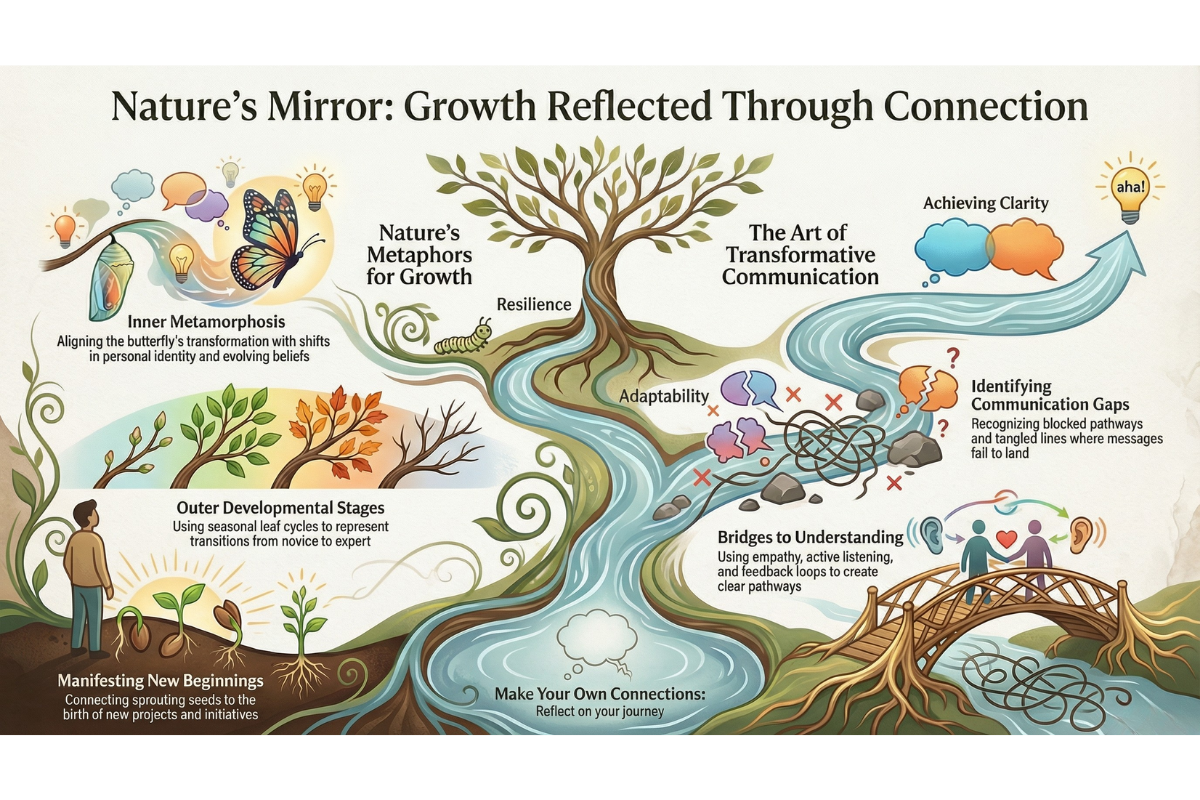
This week, we deepen our understanding of personal transformation by looking to the natural world as a mirror. The goal is to associate the external transformative processes we see in nature, like a caterpillar becoming a butterfly, with aspects of ourselves. The practice is communication, focusing on how we can achieve true understanding and connection with others. The value is learning from our environment and the natural world, recognizing that our inner changes are often in sync with the cycles happening around us. This alignment of our inner and outer worlds is where true transformation occurs.
The Concept: Finding Yourself in Nature’s Transformations
Last week, we asked, “What is transformation?” This week, we take that question a step further. We will explore how to connect the powerful, visible transformations in the natural world to the quiet, invisible transformations happening within us. This is not just a poetic idea. It is a practical tool for self-awareness.
The caterpillar literally dissolves itself before it becomes a butterfly. This is a profound and total reinvention. We do not experience this physically. Our fingers do not dissolve and become wings. But inwardly? We absolutely can. A challenging life experience, a new relationship, a deep insight—these things can dissolve our old sense of self and allow a new one to emerge. This is the human equivalent of metamorphosis. It is a core concept in many psychological and spiritual traditions, often referred to as a process of ego death and rebirth.
This week, your work is to observe the natural world around you. Look at a plant as it goes through its life cycle. Watch the leaves change color and fall. Then, ask yourself: What part of me is like that? For example, our bodies are in a constant state of renewal. Every seven years or so, nearly every cell in your body is replaced. This is a quiet, slow transformation, much like a leaf budding, growing, and eventually falling. By making these connections, you start to see your own life as part of a larger, natural rhythm of change.
| Natural Transformation | The Core Process | The Human Parallel |
|---|---|---|
| Caterpillar to Butterfly |
A complete dissolution and rebuilding of self.
|
A profound inner shift in identity or beliefs after a major life event. |
| The Life Cycle of a Plant | A journey through budding, growth, decay, and renewal. | The natural cycles of effort, success, failure, and learning in our own lives. |
| The Changing of Seasons | A predictable, cyclical shift in the entire environment. | The different “seasons” of our lives: periods of growth, rest, and transition. |
The 3-Step Practice: The Communication of Transformation
This week’s practice is about communication. How can our communication lead to a transformative understanding, both with ourselves and with others? It starts with the courage to be honest about what we do and do not understand.
| Step | Title |
Action / Guiding Question
|
|---|---|---|
| 1 | Concept: Nature as a Mirror | What is it? Use the transformative processes in the natural world as analogies for your own inner changes. |
| 2 | Practice: Transformative Communication | Do I truly understand? Pay attention to moments of connection and disconnection in your conversations. |
| 3 | Value: I Learn from My Environment |
How am I aligned with the world around me? Notice the parallels between your inner state and the changes happening in your environment.
|
Step 1: The Concept – Nature as a Mirror
The core idea this week is to use the natural world as a tool for self-reflection. When you see a tree lose its leaves, you are not just seeing a tree. You are seeing a model of how to let go. When you see a seed sprout, you are seeing a model of your own potential. This is not just a metaphor. It is a way of training your brain to see the universal patterns of growth and change in your own life. This practice of finding personal meaning in the natural world is a cornerstone of ecopsychology.
Step 2: The Practice – Transformative Communication
Your focus this week is communication. But not just any communication. We are talking about the kind of communication that leads to a shared, transformative understanding. This requires a high level of self-awareness.
- Guiding Questions for Your Practice:
- In conversations, when do you feel truly connected and understood? What does that feel like in your body?
- When do you pretend to understand something you don’t? What is the fear or impulse that makes you do that?
- What are the qualities of your communication that lead to those moments of real connection? Are you asking questions? Are you listening deeply? Are you being honest about your own confusion?
This is not about being a perfect communicator. It is about being an honest one. The goal is to stay in touch with yourself during a conversation, so you can notice when you are truly connected and when you are just going through the motions. This is a key skill for building authentic relationships.
Step 3: The Value – I Learn from My Environment
Finally, we connect this to the value: I learn from my environment/natural world. This is where the inner and outer work come together. As you observe the changes happening in the natural world around you, you also observe the changes happening within you. You start to notice the parallels. You might feel a burst of creative energy in the spring, or a need to rest and reflect in the winter. This is not a coincidence. It is a sign that you are in sync with the natural rhythms of life.
- The Scenario: You are feeling stuck and unmotivated in a project.
- The Practice: You go for a walk and notice that the trees are bare. It is the middle of winter. You realize that this is a season for rest and quiet reflection, not for forced growth. You give yourself permission to slow down, trusting that a new season of energy will come.
This is the alignment we are looking for. When your inner environment and your outer environment come into harmony, the conditions are perfect for transformation. You are no longer fighting against the current. You are flowing with it.
Conclusion: Finding Your Place in the Cycle of Change
Personal transformation is not a solo journey. It is a dance with the world around us. By looking to nature, we can find mirrors for our own inner processes. By practicing honest communication, we can build bridges of understanding with others. And by aligning our inner and outer worlds, we can find our place in the great, cyclical rhythm of change.
This week, look outside. Then, look inside. See if you can find the connection. That is where the magic of transformation begins.
Anatomy of Growth Video Series
Join Meristem’s Executive Director, Erin Schirm, as he breaks down the concepts, practices, and values that drive personal transformation. Each video offers a practical framework you can apply to your own life—from self-reflection to movement to communication. Discover how growth really works, one insight at a time. It starts with you.