Audio Overview
Key Takeaways: The Freedom of a Manageable Choice
This week, we explore freedom of choice through a new lens: the size of the picture. True freedom isn’t about having infinite options; it’s about having the right options for our current stage of understanding. Too much information can lead to decision paralysis, while too little can be disempowering. By practicing mindful communication and recognizing ourselves as the catalyst for change, we can find the “Goldilocks Zone” of choice that fosters genuine growth and self-determination.
More Options, Less Freedom? The Paradox of Choice
Last week, we began to question the nature of freedom, looking at how it relates to consequence and our own internal drives. This week, we dive into its most celebrated aspect: the freedom to choose. We often believe that the epitome of freedom is our ability to choose what we do, when we do it, and how we do it. But what if the sheer number of choices, or the amount of information we have, could actually inhibit our freedom?
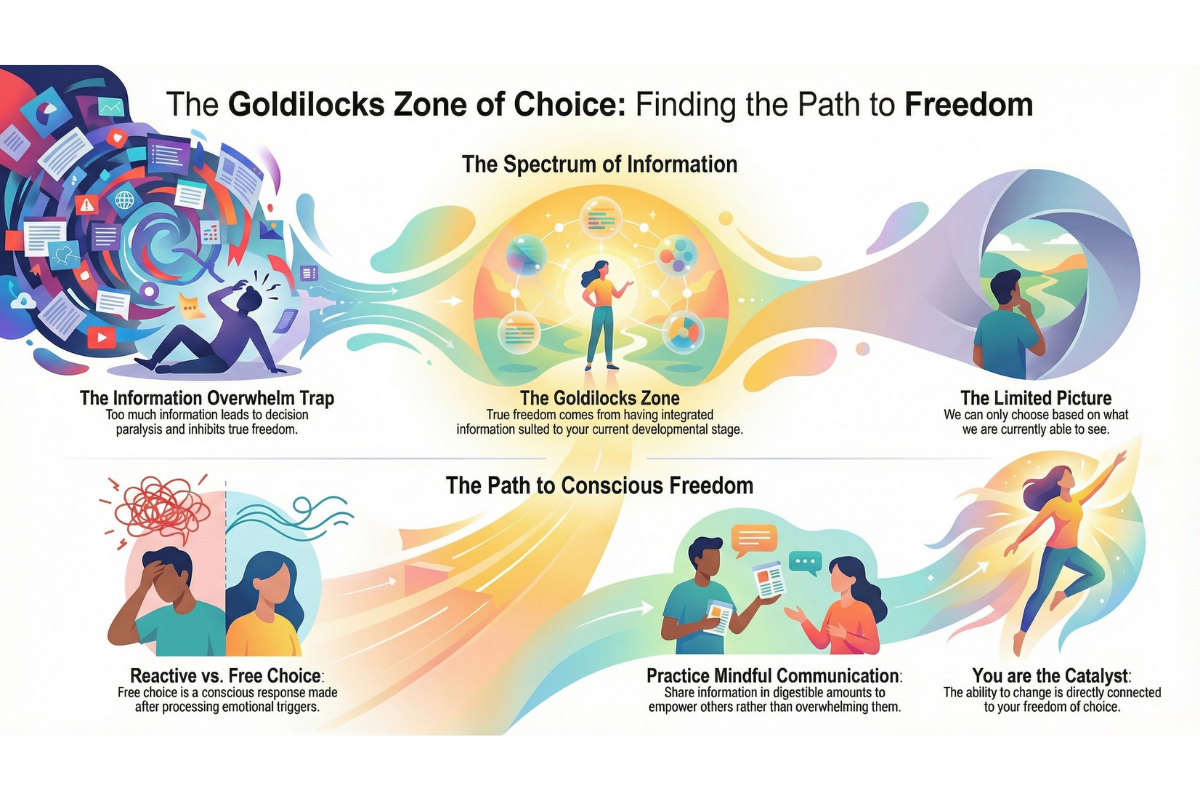
Think back on a decision you made years ago. With the clarity of hindsight, you might say, “If only I had known then what I know now.” The picture is bigger today. But the reality is, we are only ever ready for the picture we can see in the moment. Being handed a picture that’s too big (one filled with information we lack the tools to integrate) doesn’t lead to better choices. It leads to overwhelm. This phenomenon is well-documented in psychology as information overload or the paradox of choice, where an abundance of options can surprisingly lead to anxiety, indecision, and dissatisfaction.
| The Challenge of Choice | Description |
|---|---|
| The Limited Picture | Our choices are always based on our current, incomplete understanding of the world. |
| The Overwhelming Picture | When given too much information, we can experience decision paralysis, making it harder to choose freely. |
| The “Goldilocks” Picture | True freedom lies in having the right amount of information to make a clear, integrated, and empowered choice. |
The 3-Step Practice: Navigating the Landscape of Choice
This week’s practice is about finding the balance between freedom and the ability to manage it, both for ourselves and in our interactions with others.
| Step | Title | Action / Guiding Question |
|---|---|---|
| 1 | Concept: The Manageable Choice | What is it? Recognize that freedom isn’t about infinite options, but about having the right amount of information to make a clear choice. |
| 2 | Practice: Mindful Communication | Am I opening or closing doors? Notice how the amount of information you share can either empower someone to choose or overwhelm them into inaction. |
| 3 | Value: I Am the Catalyst | Am I reacting or responding? Reflect on whether your choices are a direct reaction to external events or a conscious response from a place of inner freedom. |
Step 1: The Concept – The Freedom of a Manageable Choice
The first step is to reframe our understanding of freedom. It’s not about having access to every possible path at once. It’s about being presented with the paths we are equipped to walk right now. This is the foundation of effective learning and personal development, often referred to as scaffolding in educational psychology. A learner is given just enough support to tackle a new problem, and that support is gradually removed as their own ability grows.
Too much freedom, too soon, is like being asked to build a house with no blueprint. The materials are all there, but the cognitive load of figuring out how to assemble them is so immense that you can’t even start. True freedom is being handed a blueprint you can understand.
Step 2: The Practice – Mindful Communication
This week, your practice is to observe this dynamic in your communication. Every conversation is an opportunity to either open a door for someone or to overwhelm them. Pay attention to how much information you are sharing and, more importantly, how it is being received.
- The Scenario: A colleague is learning a new task, and you know every possible pitfall and shortcut.
- The Practice: Instead of downloading all your knowledge at once, notice their current level of understanding. Are they ready for the advanced tips, or do they just need to master the first step?
- Guiding Questions for Your Practice:
- Am I giving enough information for them to make a clear choice?
- Am I giving so much information that I am making the choice for them, or causing them to shut down?
- How can I present this information in a way that empowers them to step more fully into their own freedom?
Step 3: The Value – I Am the Catalyst for My Own Freedom
Finally, we turn this lens inward with the value: I am the catalyst for my own change. Your ability to be free is directly connected to how you process the world around you. This week, reflect on the origin of your choices.
- The Reactive Choice: An email lands in your inbox with an urgent, demanding tone. You immediately fire back a defensive reply. Your choice was a direct, almost automatic, reaction to an external event.
- The Free Choice: The same email arrives. You notice the demanding tone and the feeling of defensiveness it triggers in you. You pause. You process it. You free yourself from the initial emotional hook. From that place of inner freedom, you choose a response—one that is calm, clear, and strategic.
This is the essence of developing an internal locus of control—the belief that you are the primary author of your life’s events. You are no longer a pinball reacting to external forces, but the player, consciously choosing your next move.
Conclusion: The Art of the Empowered Choice
Freedom is not a destination of infinite options. It is the dynamic, ongoing practice of finding the right-sized picture for the moment we are in. It is the art of communicating with others in a way that respects their current picture. And most importantly, it is the discipline of freeing ourselves from our own reactivity so that we can make choices that are truly our own.
This week, embrace the power of the manageable choice. Notice it, practice it, and become the catalyst for your own, authentic freedom.
Anatomy of Growth Video Series
Join Meristem’s Executive Director, Erin Schirm, as he breaks down the concepts, practices, and values that drive personal transformation. Each video offers a practical framework you can apply to your own life—from self-reflection to movement to communication. Discover how growth really works, one insight at a time. It starts with you.