Introduction
In the world of education, the word “resistance” often carries a negative connotation. It can bring to mind images of a student who is defiant, oppositional, or unwilling to learn. For autistic students, this label can be particularly damaging, often leading to misunderstandings and ineffective interventions. But what if we reframed our understanding of resistance entirely? What if, instead of viewing it as a barrier to be eliminated, we saw it as a vital sign—an indicator that a student is on the very edge of their learning, grappling with a challenge that is meaningful and, ultimately, essential for growth?
This is the core principle behind the concept of productive struggle. It is the idea that deep, authentic learning doesn’t happen when things are easy. It happens when we are challenged just beyond our current abilities and must work to find a new solution. For autistic young adults, who may have been shielded from challenges or taught to rely on rigid, pre-learned scripts, learning how to navigate this productive struggle is one of the most important skills they can develop. It is the very foundation of resilience, problem-solving, and true independence.
This article will explore the surprising power of resistance in autism education. We will delve into the psychology of productive struggle, explain how it builds critical executive function skills, and introduce the “Restepping” methodology used at Meristem—a structured approach to embracing and learning from moments of challenge. By the end, you will see resistance not as a problem to be solved, but as an opportunity to be harnessed for profound and profound growth.
Redefining Resistance: From Opposition to Opportunity
Before we can harness the power of resistance, we must first redefine it. In a traditional educational context, a student who says “I can’t do this,” pushes their work away, or becomes visibly frustrated might be labeled as “non-compliant” or “oppositional.” This behavioral lens, however, misses the crucial information that the resistance is providing. More often than not, this resistance is a signal that the student has hit the edge of their current skill set and is experiencing the cognitive and emotional discomfort that comes with it.
This discomfort is the gateway to productive struggle. Coined by mathematics educator Dr. Hiebert, productive struggle is the process of expending effort to make sense of something, to grapple with problems that are not immediately solvable [1]. It is the critical space between a task being so easy that it requires no thought, and so hard that it leads to unproductive frustration and shutdown. It is in this zone of optimal challenge that the brain is primed for growth.
| Type of Struggle | Characteristics | Outcome for the Learner |
|---|---|---|
| Unproductive Frustration | The task is far beyond the learner’s current ability. No clear path forward is visible. Support is absent or ineffective. | Anxiety, shutdown, feelings of hopelessness, and a reinforced belief that “I can’t do it.” |
| Productive Struggle | The task is challenging but achievable with effort. The learner has some relevant prior knowledge. Scaffolding and support are available. | Resilience, deeper understanding, increased self-efficacy, and the development of new problem-solving strategies. |
For an autistic young adult, resistance is often a raw, unfiltered signal that they have entered this zone. Because of differences in emotional regulation and interoception (the sense of the internal state of the body), the feeling of being stuck can be intensely uncomfortable. Their reaction—whether it’s verbalizing frustration, withdrawing, or becoming agitated—is not a sign of defiance. It is a sign that their brain is working hard, grappling with a new challenge, and that they need the right kind of support to push through rather than give up.
The educator’s role, then, is not to eliminate the struggle by giving the answer or making the task easier. It is to act as a guide, providing just enough scaffolding to keep the student in the productive zone. It is about transforming the thought “I can’t do this” into the more powerful and accurate thought, “I can’t do this yet.”
The Brain-Building Power of Productive Struggle
Why is actively embracing moments of struggle so important? Because the process of navigating challenges is one of the most effective ways to build executive function skills. These are the complex cognitive processes that control and coordinate our thoughts and actions, including skills like planning, problem-solving, working memory, and cognitive flexibility. For many autistic individuals, these skills can be a significant area of challenge, and they are rarely developed through passive learning.
Productive struggle is like a workout for the brain’s executive function networks. When a student is faced with a problem that they don’t immediately know how to solve, they are forced to engage these higher-order thinking skills.
| Executive Function Skill | How Productive Struggle Builds It |
|---|---|
| Problem-Solving | The very act of being “stuck” requires the learner to analyze the situation, identify the obstacle, and brainstorm potential solutions. This is the core of all problem-solving. |
| Cognitive Flexibility | When the first approach doesn’t work, the learner must abandon that strategy and try something new. This builds the mental agility to shift perspectives and adapt to changing circumstances. |
| Working Memory | Grappling with a complex task requires holding multiple pieces of information in mind at once, manipulating them, and using them to guide action. |
| Emotional Regulation | Experiencing the frustration of a challenge and learning to work through it without giving up is a powerful lesson in emotional regulation. It teaches students that feelings of discomfort are temporary and manageable. |
| Initiation | Overcoming a challenge provides a powerful dopamine reward, which reinforces the neural pathways associated with task initiation. It teaches the brain that starting a difficult task can lead to a feeling of accomplishment. |
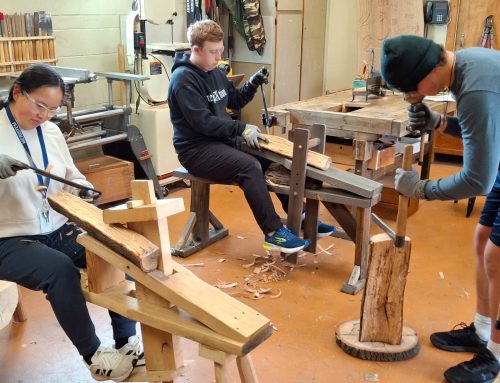
Think of a student in a woodworking class who is trying to make a dovetail joint. Their first attempt doesn’t fit. This is a moment of resistance. To succeed, they can’t just follow a script; they must engage their executive functions. They must problem-solve (Why doesn’t it fit?), demonstrate cognitive flexibility (The way I cut it was wrong; I need a new approach), use their working memory (I need to hold the angle of the chisel just so, while applying the right amount of pressure), and regulate their emotions (This is frustrating, but I can try again). When the joint finally slides into place, the sense of accomplishment is profound. They haven’t just learned to make a joint; they have strengthened the very cognitive skills they need to navigate a complex and unpredictable world.
The Meristem Method: “Restepping” Through Resistance
Understanding the value of productive struggle is one thing; creating a safe and effective system to guide students through it is another. At Meristem, we have developed a core pedagogical practice for this very purpose, which we call “Restepping.” This approach aligns with growth mindset research showing that challenges are opportunities for brain development. Restepping is our structured, compassionate approach to navigating the moments of resistance that are inherent in the learning process. It is a method for transforming a moment of frustration into a powerful learning opportunity.
The Restepping process is initiated whenever a student hits a wall—when they become stuck, frustrated, or overwhelmed by a task. Instead of either allowing them to give up or providing the solution, our instructors are trained to guide them through a deliberate, multi-step process of reflection and problem-solving.
The Four Steps of Restepping
- Step Back and Regulate: The first and most critical step is to pause. The instructor guides the student to step away from the immediate source of frustration—physically and mentally. This might involve taking a short walk, getting a drink of water, or simply taking a few deep breaths. The goal is to co-regulate and downshift the nervous system from a state of fight-or-flight to a calmer, more resourceful state where thinking and reflection are possible. This step acknowledges the validity of the student’s emotional experience without judgment.
- Analyze the Process (Not the Person): Once the student is in a more regulated state, the instructor facilitates a non-judgmental analysis of the process. The focus is never on what the student did “wrong,” but on the steps of the task itself. The language is neutral and observational. For example: “Let’s walk through the steps you took. You heated the metal, then you placed it on the anvil, and then you struck it here. What did you observe when that happened?”
- Identify the Point of Breakdown: Through this collaborative analysis, the student and instructor work together to pinpoint the exact moment where the process broke down. Was it a miscalculation in measurement? A misunderstanding of a specific step? A moment of lost focus? Identifying this single, specific point is incredibly empowering. It transforms a vague, overwhelming feeling of “I can’t do this” into a specific, solvable problem: “The chisel was at the wrong angle at this one particular moment.”
- Re-engage with a New Strategy: With the problem clearly identified, the final step is to brainstorm and attempt a new strategy. The instructor doesn’t give the answer but asks guiding questions: “What could we try differently at that step?” “What if we adjusted the angle like this?” The student then “resteps” back into the process, re-engaging at the point of breakdown, armed with a new approach and a renewed sense of agency.
This Restepping cycle is a microcosm of the entire experiential learning process. It is a structured way of facilitating Kolb’s cycle in real-time, at the precise moment of challenge. It teaches students a meta-skill: the process of how to learn from mistakes. By practicing this cycle over and over in a supportive environment, our students internalize a powerful new mental model. They learn that being stuck is not a sign of failure, but a signal to Step Back, Analyze, Identify, and Re-engage. This is the foundational algorithm for resilience.

Conclusion: Building Resilience, One Challenge at a Time
In education, our natural instinct is often to create a path of least resistance for our students, believing that a smooth journey is a successful one. But for autistic young adults, a life without challenge is a life without growth. The reality is that the world is not a perfectly scaffolded, predictable environment. To thrive in it, individuals need more than just pre-learned skills; they need the resilience, cognitive flexibility, and emotional regulation to navigate the unexpected. This is the profound gift of productive struggle.
By reframing resistance not as defiance but as a signal of learning, we open up a powerful new avenue for building true competence. Embracing moments of challenge—within a supportive and structured framework—is the most effective way to develop the critical executive function skills that are the bedrock of independence. It is through the process of grappling with a problem, analyzing what went wrong, and trying a new approach that students learn the invaluable lesson that they are capable of overcoming adversity.
Meristem’s Restepping method provides a clear, compassionate, and replicable process for turning these moments of frustration into catalysts for growth. It is a methodology that honors the student’s emotional experience while empowering them with a concrete strategy for problem-solving. By repeatedly stepping back, analyzing, identifying, and re-engaging, our students don’t just learn how to complete a task; they learn how to learn. They build a deep, embodied confidence in their own ability to meet a challenge and emerge stronger on the other side.
Ultimately, the goal of education is to prepare young adults for a future we cannot predict. We cannot give them a script for every possible scenario, but we can give them the resilience to write their own. By embracing the surprising power of resistance, we can help autistic young adults build not just skills, but the unshakeable self-knowledge that they have what it takes to navigate any challenge that comes their way.
Take the Next Step
Learning to guide a student through productive struggle is a skill that requires training, patience, and a deep understanding of neurodiversity. At Meristem, our entire staff is trained in the Restepping method and our program is designed to create a safe environment for this transformative work.
Discover Meristem’s Unique Approach to Autism Education to learn more about how we build resilience and independence in our students.
References[1] Hiebert, J., & Grouws, D. A. (2007). The effects of classroom mathematics teaching on students’ learning. In F. K. Lester, Jr. (Ed.), Second handbook of research on mathematics teaching and learning (pp. 371–404). Information Age Publishing.
Voices of Community Podcast
Join us for conversations with autistic adults, families, and professionals who are helping shape a more inclusive world. Each episode shares personal stories, insights, and perspectives from across the Meristem community and beyond.