Key Takeaways: Unpacking Freedom
This month, we begin a new exploration into the concept of freedom. It’s a word we use often, but what does it truly mean? This week, we challenge the surface-level definition by examining its relationship with consequence, choice, and our own internal drives. By practicing presence and focusing our energy on what we can control, we can cultivate a sense of personal freedom and self-determination, even when faced with external and internal constraints.
Are You Truly Free? A Deeper Look at Choice and Consequence
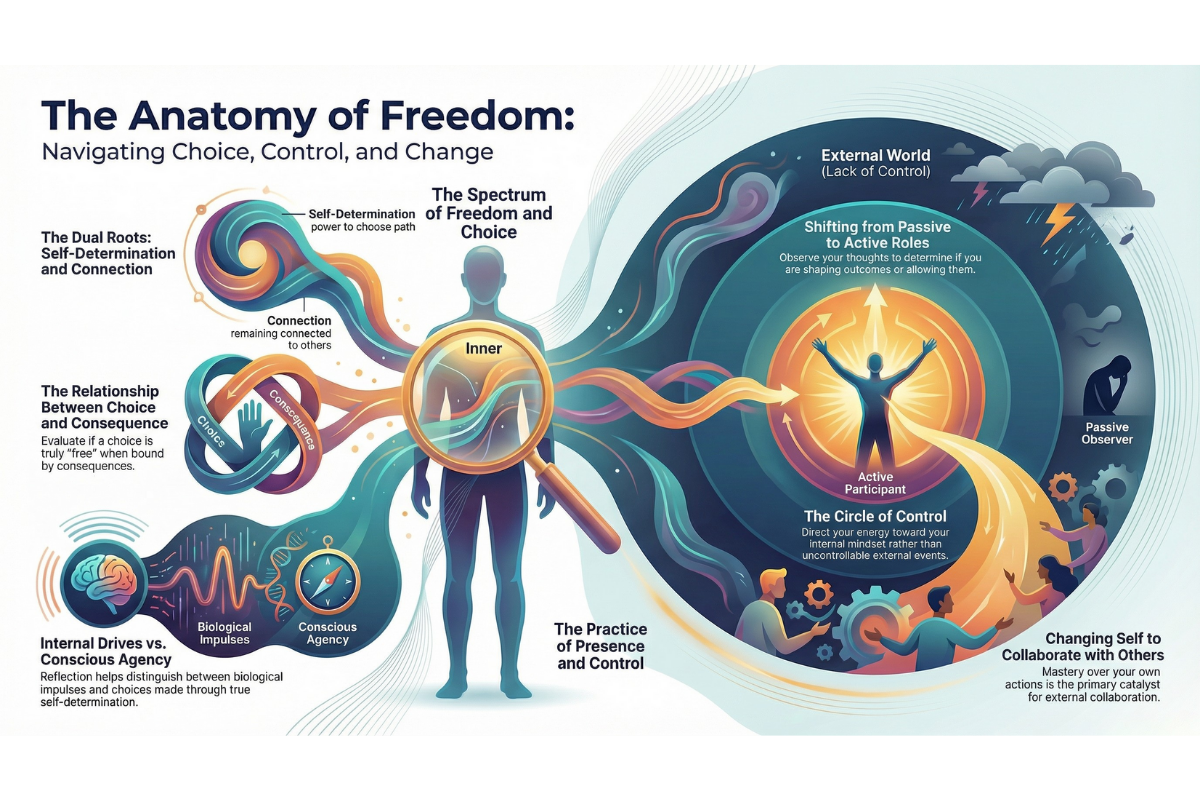
Freedom. The word itself feels expansive, evoking images of open roads and limitless possibilities. But when we pause to examine it, the concept quickly becomes a fascinating paradox. Its ancient roots connect it not just to the power of self-determination, but also to the idea of being a “beloved friend”—a state of being valued and connected. This suggests that true freedom isn’t about radical, isolated independence, but about a healthy relationship with ourselves and the world.
This month, we invite you to ponder what freedom really means. It’s easy to say, “I have free choice,” but is any choice ever truly free from consequence? This question touches on the age-old philosophical debate between free will and determinism. If you are “free” to stop eating, the consequence is death. If you are “free” to ignore the need for air, the consequence is suffocation. This reveals a fundamental truth: our existence is bound by a web of cause and effect. Does this mean we are never truly free?
| Core Question | The Paradox |
|---|---|
| Freedom from What? | Can we be free from the environment we depend on for survival (air, food, water)? |
| Freedom & Consequence | If every choice has a consequence, even an undesirable one, is the choice still considered free? |
| Freedom & Internal Drives | If hunger drives you to eat, did you make a free choice, or was the action determined by your biology? |
These questions aren’t meant to be answered easily. They are designed to move us beyond a simplistic view of freedom and toward a more nuanced understanding of personal agency. In fact, some research suggests that an overabundance of options can lead to anxiety and dissatisfaction, a phenomenon known as the “paradox of choice”.
The 3-Step Practice: Cultivating Inner Freedom
This week’s practice is about finding freedom not by changing our external world, but by changing our relationship with our inner world.
| Step | Title | Action / Guiding Question |
|---|---|---|
| 1 | Concept: The Nature of Freedom | What is it? Ponder the relationship between freedom, choice, and consequence. Question where your agency truly lies. |
| 2 | Practice: Radical Presence | What is driving me? Pay attention to your actions, feelings, and thoughts. Notice when you are consciously choosing them versus when they are being driven by something else (e.g., hunger, habit, fear). |
| 3 | Value: I Am the Change | What can I control? Focus your energy on the things you have the power to change (your responses, your effort) rather than the things you don’t. |
Step 1: The Concept – Pondering the Paradox
This first step is purely reflective. Allow your mind to grapple with the questions above. The goal isn’t to find a definitive answer but to appreciate the complexity. When we question the nature of our choices, we begin the process of waking up from autopilot. This very act of questioning is a step toward a more conscious, self-determined existence, a core component of what many psychologists refer to as developing an “internal locus of control”.
Step 2: The Practice – Radical Presence
With the conceptual questions in mind, the practice this week is Presence. The goal is to become an impartial observer of your own life. Pay attention to the driving forces behind your actions, feelings, and thoughts.
- The Scenario: You find yourself reaching for a bag of potato chips.
- The Question: Pause and ask, “What is driving this action?” Is it a conscious, free choice where you’ve decided you’d enjoy a snack? Or is it an unconscious reaction to boredom, stress, or a biological craving?
There is no “right” or “wrong” answer. The practice is simply to notice. By noticing, you create what psychiatrist and Holocaust survivor Viktor Frankl identified as the space between stimulus and response. In that space lies our power to choose our response. In that space lies our growth and our freedom.
Step 3: The Value – I Am the Change (Focusing on Control)
This brings us to the value: I am the change I wish to see. This value is about collaboration with reality. It begins by honestly assessing what you can and cannot control. Much of our frustration and feeling of being “unfree” comes from pouring our energy into things that are outside our sphere of influence.
As explained by Self-Determination Theory, a leading psychological framework, a key component of well-being is the feeling of autonomy—the sense that we are the authors of our own lives. This doesn’t mean controlling everything, but rather directing our own behavior and choices within the constraints we face.
| Circle of Control | Examples |
|---|---|
| Things I Can Control | My effort, my attitude, my response to a situation, the words I choose, where I put my focus. |
| Things I Cannot Control | The weather, traffic, other people’s opinions, the past, economic conditions. |
This week, notice where you are spending your energy. Are you caught in a loop of frustration about things you cannot change? Or are you investing your energy in the one area where you are truly free to act: yourself? This focus on internal control is a cornerstone of building resilience and mental well-being.
Conclusion: Freedom as a Practice, Not a Destination
True freedom may not be the absence of constraints, but the ability to consciously choose our response to them. It’s found in the pause between impulse and action. It’s found in directing our energy toward what we can influence. And it’s found in the humble acceptance that while we may not control the world, we can always strive to be the conscious, active authors of our own lives.
References
[1] Simply Psychology. (2023). Freewill vs Determinism In Psychology.
[2] The Decision Lab. (n.d.). The Paradox of Choice.
[3] Verywell Mind. (2022). What Is Locus of Control?
[4] Psychology Today. (n.d.). Locus of Control.
Anatomy of Growth Video Series
Join Meristem’s Executive Director, Erin Schirm, as he breaks down the concepts, practices, and values that drive personal transformation. Each video offers a practical framework you can apply to your own life—from self-reflection to movement to communication. Discover how growth really works, one insight at a time. It starts with you.