Audio Overview
Key Takeaways: The Initiator of Movement
This week, we conclude our four-week exploration of movement by asking the most fundamental question: What starts it all? We introduce the concept of the “Inner Initiator”—the part of you that sparks change. By aligning your intention (the Initiator) with your attention (your focus), you can consciously create shifts in your posture, emotions, and thoughts, leading to a more balanced and effective life.
From Awareness to Action: What Sparks the First Move?
For the past month, we have journeyed through the multifaceted world of movement. We started by defining it not just as a physical act, but as any shift in our posture, emotions, or thoughts. We explored the dynamic between our inner and outer worlds and even got curious about the invisible “substance” of our presence. Now, we arrive at the final and most powerful piece of the puzzle: What gets movement started?
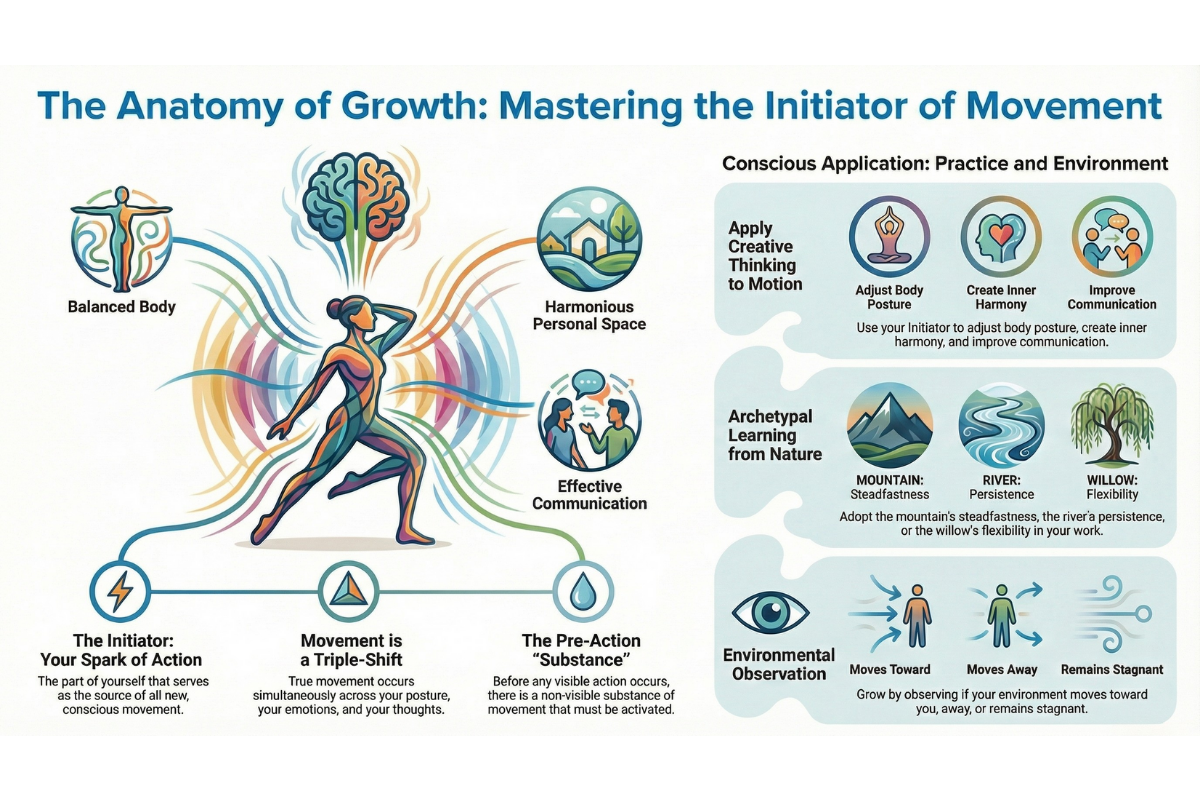
If you’ve ever felt stuck, waiting for motivation to strike, this question is critical. The answer lies in discovering your Inner Initiator—the part of yourself that is the source of all new movement. It’s the spark that precedes the flame, the decision before the action. As we’ll explore, this Initiator is deeply connected to your intention. It’s the force that gets the “substance” of your being moving and sets the triple shift of body, heart, and mind in motion.
| Week | Concept Explored | Key Question |
|---|---|---|
| 1 | The Definition of Movement | What is movement beyond the physical? |
| 2 | Inner & Outer Worlds | How does my internal state affect my external presence? |
| 3 | The Substance of Movement | What is the invisible energy or space around me? |
| 4 | The Initiator of Movement | What is the spark that starts it all? |
The 3-Step Practice: Igniting Conscious Change
This week’s practice integrates everything we’ve learned into a framework for conscious, self-directed change.
| Step | Title | Action / Guiding Question |
|---|---|---|
| 1 | Concept: The Inner Initiator | What is it? Identify the part of you that starts movement. Recognize this as your power of intention. |
| 2 | Practice: Creative Thinking | How can I use it? Apply your understanding of movement in new ways to adjust your body, balance your energy, and improve communication. |
| 3 | Value: Learning from the World | What is it teaching me? Observe movement in your environment and nature as feedback, learning from its patterns to inform your own. |
Step 1: The Concept – Finding Your Inner Initiator
The first step is to get acquainted with the part of you that makes the first move. Think of it as the CEO of your being—the one who gives the directive. More often than not, this Initiator is simply your intention. Where you place your intention is where movement begins.
- If your intention is inward, focused on self-reflection, you might find yourself becoming quieter, your posture turning inward, and your thoughts becoming more introspective.
- If your intention is outward, aimed at connecting with someone, you might lean forward, your energy extending towards them, and your words becoming more engaging.
This isn’t a mystical idea. It’s about the power of focused will. As research from institutions like the Max Planck Institute has shown, the brain begins preparing for an action seconds before we are consciously aware of the decision. Your intention is that deep, foundational command. The practice is to bring that command into your conscious awareness.
Step 2: The Practice – Creative Thinking in Motion
Now that you’ve identified your Initiator, the practice is to use it creatively. Look back at the feedback and experiences from the last few weeks. Was there a conversation that fell flat? A moment you felt physically tense? A time you felt emotionally stuck? This is your laboratory.
- Guiding Questions for Your Practice:
- Adjust Your Body: Can you use your intention to consciously release the tension in your shoulders before a difficult meeting? Can you initiate a posture of openness to feel more receptive?
- Balance Your Energy: If you feel scattered, can you set an intention to gather your “substance” or personal space closer to you? If you feel withdrawn, can you intend to expand it?
- Engage in Communication: Before speaking, what if you initiate movement by setting a clear intention? For example: “My intention is to understand,” or “My intention is to connect.” How does that change the words you choose and the way they are received?
Step 3: The Value – Learning from the Natural World
Finally, we ground our practice in the value: I learn from my environment. Your Initiator doesn’t operate in a vacuum; it responds to and is informed by the world around you. The natural world provides a masterclass in movement.
- Observe Your Environment: Look at the world through a movement lens. Is the culture in your office moving quickly and erratically, or is it stagnant? Is the energy in a room moving towards you or away from you? This is all valuable feedback.
- Learn from Nature’s Archetypes: Nature provides powerful examples of intentional movement that we can embody.
| Archetype | Quality of Movement | How to Embody It |
|---|---|---|
| The Mountain | Steadfast, present, grounded | When you need stability, initiate a feeling of rootedness and unshakeable presence. |
| The River | Persistent, adaptable, flowing | When you face an obstacle, initiate a mindset of flexibility, finding a way around it without losing momentum. |
| The Willow Tree | Flexible, resilient, yielding | When you feel rigid or brittle, initiate a physical and emotional state of bending without breaking. |
By observing these patterns, you can consciously choose to initiate a different way of being, using these natural archetypes as your guide.
Conclusion: Aligning Intention with Attention
The ultimate goal is to create harmony between your intention (your Inner Initiator) and your attention (your focus). When what you intend to do and what you are focused on are one and the same, you achieve aligned movement. Your communication becomes clearer, your actions become more effective, and your inner state becomes more balanced.
This week, don’t feel pressured to have a perfect answer to the question, “What initiates movement?” The exploration itself is the prize. Simply by asking the question and observing, you are awakening the possible. You are learning to be the conscious creator of your own change.
Anatomy of Growth Video Series
Join Meristem’s Executive Director, Erin Schirm, as he breaks down the concepts, practices, and values that drive personal transformation. Each video offers a practical framework you can apply to your own life—from self-reflection to movement to communication. Discover how growth really works, one insight at a time. It starts with you.